Wednesday, January 11, 2012


Monday, November 28, 2011
Monday, July 11, 2011
Wednesday, November 3, 2010
Thursday, August 26, 2010
Wednesday, December 9, 2009
Saint Juan Diego

"Thousands of people gathered in the Basilica of Our Lady of Guadalupe July 31, 2002, for the canonization of Juan Diego, to whom the Blessed Mother appeared in the 16th century. Pope John Paul II celebrated the ceremony at which the poor Indian peasant became the Church’s first saint indigenous to the Americas.
The Holy Father called the new saint “a simple, humble Indian” who accepted Christianity without giving up his identity as an Indian. “In praising the Indian Juan Diego, I want to express to all of you the closeness of the church and the pope, embracing you with love and encouraging you to overcome with hope the difficult times you are going through,” John Paul said. Among the thousands present for the event were members of Mexico’s 64 indigenous groups.
"First called Cuauhtlatohuac (“The eagle who speaks”), Juan Diego’s name is forever linked with Our Lady of Guadalupe because it was to him that she first appeared at Tepeyac hill on December 9, 1531. The most famous part of his story is told in connection with the Feast of Our Lady of Guadalupe (December 12). After the roses gathered in his tilma were transformed into the miraculous image of Our Lady of Guadalupe, however, little more is said about Juan Diego.
"In time he lived near the shrine constructed at Tepeyac, revered as a holy, unselfish and compassionate catechist who taught by word and especially by example.
"During his 1990 pastoral visit to Mexico, Pope John Paul II confirmed the long-standing liturgical cult in honor of Juan Diego, beatifying him. Twelve years later he was proclaimed a saint." (From A Saint A Day, American Catholic.org)
Thursday, October 15, 2009
St Teresa of Avila

"In the Autobiography which she completed towards the end of her life, Saint Teresa of Avila gives us a description of her parents, along with a disparaging estimate of her own character. "The possession of virtuous parents who lived in the fear of God, together with those favors which I received from his Divine Majesty, might have made me good, if I had not been so very wicked." A heavy consciousness of sin was prevalent in sixteenth-century Spain, and we can readily discount this avowal of guilt. What we are told of Teresa's early life does not sound in the least wicked, but it is plain that she was an unusually active, imaginative, and sensitive child. Her parents, Don Alfonso Sanchez de Capeda and Dona Beatriz Davila y Ahumada, his second wife, were people of position in Avila, a city of Old Castile, where Teresa was born on March 28, 1515. There were nine children of this marriage, of whom Teresa was the third, and three children of her father's first marriage.
"Piously reared as she was, Teresa became completely fascinated by stories of the saints and martyrs, as was her brother Roderigo, who was near her own age and her partner in youthful adventures. Once, when Teresa was seven, they made a plan to run away to Africa, where they might be beheaded by the infidel Moors and so achieve martyrdom. They set out secretly, expecting to beg their way like the poor friars, but had gone only a short distance from home when they were met by an uncle and brought back to their anxious mother, who had sent servants into the streets to search for them. She and her brother now thought they would like to become hermits, and tried to build themselves little cells from stones they found in the garden. Thus we see that religious thoughts and influences dominated the mind of the future saint in childhood...continued at EWTN here.
Sunday, October 4, 2009
Feast of St. Francis of Assisi

"Francis of Assisi was a poor little man who astounded and inspired the Church by taking the gospel literally—not in a narrow fundamentalist sense, but by actually following all that Jesus said and did, joyfully, without limit and without a mite of self-importance.
Serious illness brought the young Francis to see the emptiness of his frolicking life as leader of Assisi's youth. Prayer—lengthy and difficult—led him to a self-emptying like that of Christ, climaxed by embracing a leper he met on the road. It symbolized his complete obedience to what he had heard in prayer: "Francis! Everything you have loved and desired in the flesh it is your duty to despise and hate, if you wish to know my will. And when you have begun this, all that now seems sweet and lovely to you will become intolerable and bitter, but all that you used to avoid will turn itself to great sweetness and exceeding joy."
From the cross in the neglected field-chapel of San Damiano, Christ told him, "Francis, go out and build up my house, for it is nearly falling down." Francis became the totally poor and humble workman.
He must have suspected a deeper meaning to "build up my house." But he would have been content to be for the rest of his life the poor "nothing" man actually putting brick on brick in abandoned chapels. He gave up every material thing he had, piling even his clothes before his earthly father (who was demanding restitution for Francis' "gifts" to the poor) so that he would be totally free to say, "Our Father in heaven." He was, for a time, considered to be a religious "nut," begging from door to door when he could not get money for his work, bringing sadness or disgust to the hearts of his former friends, ridicule from the unthinking.
But genuineness will tell. A few people began to realize that this man was actually trying to be Christian. He really believed what Jesus said: "Announce the kingdom! Possess no gold or silver or copper in your purses, no traveling bag, no sandals, no staff" (see Luke 9:1-3 ).
Francis' first rule for his followers was a collection of texts from the Gospels. He had no idea of founding an order, but once it began he protected it and accepted all the legal structures needed to support it. His devotion and loyalty to the Church were absolute and highly exemplary at a time when various movements of reform tended to break the Church's unity.
He was torn between a life devoted entirely to prayer and a life of active preaching of the Good News. He decided in favor of the latter, but always returned to solitude when he could. He wanted to be a missionary in Syria or in Africa, but was prevented by shipwreck and illness in both cases. He did try to convert the sultan of Egypt during the Fifth Crusade.
During the last years of his relatively short life (he died at 44) he was half blind and seriously ill. Two years before his death, he received the stigmata, the real and painful wounds of Christ in his hands, feet and side.
On his deathbed, he said over and over again the last addition to his Canticle of the Sun, "Be praised, O Lord, for our Sister Death." He sang Psalm 141, and at the end asked his superior to have his clothes removed when the last hour came and for permission to expire lying naked on the earth, in imitation of his Lord." (From American Catholic.org - A Saint a Day)
Wednesday, September 23, 2009
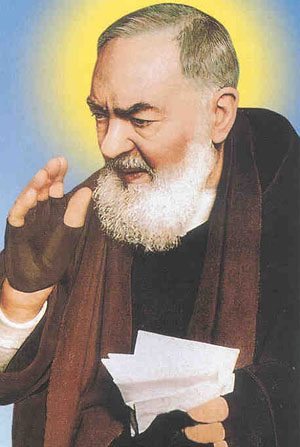
Feast of St. Padre Pio
You can check out information from the Vatican here.
"In one of the largest such ceremonies in history, Pope John Paul II canonized Padre Pio of Pietrelcina on June 16, 2002. It was the 45th canonization ceremony in Pope John Paul's pontificate. More than 300,000 people braved blistering heat as they filled St. Peter's Square and nearby streets. They heard the Holy Father praise the new saint for his prayer and charity. "This is the most concrete synthesis of Padre Pio's teaching," said the pope. He also stressed Padre Pio's witness to the power of suffering. If accepted with love, the Holy Father stressed, such suffering can lead to "a privileged path of sanctity."
Many people have turned to the Italian Capuchin Franciscan to intercede with God on their behalf; among them was the future Pope John Paul II. In 1962, when he was still an archbishop in Poland, he wrote to Padre Pio and asked him to pray for a Polish woman with throat cancer. Within two weeks, she had been cured of her life-threatening disease.
Born Francesco Forgione, Padre Pio grew up in a family of farmers in southern Italy. Twice (1898-1903 and 1910-17) his father worked in Jamaica, New York, to provide the family income.
At the age of 15, Francesco joined the Capuchins and took the name of Pio. He was ordained in 1910 and was drafted during World War I. After he was discovered to have tuberculosis, he was discharged. In 1917 he was assigned to the friary in San Giovanni Rotondo, 75 miles from the city of Bari on the Adriatic.
On September 20, 1918, as he was making his thanksgiving after Mass, Padre Pio had a vision of Jesus. When the vision ended, he had the stigmata in his hands, feet and side.
Life became more complicated after that. Medical doctors, Church authorities and curiosity seekers came to see Padre Pio. In 1924 and again in 1931, the authenticity of the stigmata was questioned; Padre Pio was not permitted to celebrate Mass publicly or to hear confessions. He did not complain of these decisions, which were soon reversed. However, he wrote no letters after 1924. His only other writing, a pamphlet on the agony of Jesus, was done before 1924.
Padre Pio rarely left the friary after he received the stigmata, but busloads of people soon began coming to see him. Each morning after a 5 a.m. Mass in a crowded church, he heard confessions until noon. He took a mid-morning break to bless the sick and all who came to see him. Every afternoon he also heard confessions. In time his confessional ministry would take 10 hours a day; penitents had to take a number so that the situation could be handled. Many of them have said that Padre Pio knew details of their lives that they had never mentioned.
Padre Pio saw Jesus in all the sick and suffering. At his urging, a fine hospital was built on nearby Mount Gargano. The idea arose in 1940; a committee began to collect money. Ground was broken in 1946. Building the hospital was a technical wonder because of the difficulty of getting water there and of hauling up the building supplies. This "House for the Alleviation of Suffering" has 350 beds.
A number of people have reported cures they believe were received through the intercession of Padre Pio. Those who assisted at his Masses came away edified; several curiosity seekers were deeply moved. Like St. Francis, Padre Pio sometimes had his habit torn or cut by souvenir hunters.
One of Padre Pio’s sufferings was that unscrupulous people several times circulated prophecies that they claimed originated from him. He never made prophecies about world events and never gave an opinion on matters that he felt belonged to Church authorities to decide. He died on September 23, 1968, and was beatified in 1999."
(From Saint of the Day, American Catholic.org)
Monday, August 31, 2009
Pope Benedict on Saint Monica
Castel Gandolfo, Italy, Aug 30, 2009 / 11:14 am (CNA).- At Sunday’s Angelus prayer in the courtyard of Castel Gandolfo’s apostolic palace, Pope Benedict XVI recalled the previous week’s liturgical memorial of St. Monica, mother of St. Augustine of Hippo and model and patron of Christian mothers.
“Much is recounted about her in her son’s autobiography ‘The Confessions,’ a masterpiece among the most read works of all time,” Pope Benedict said. “There, we understand that St. Augustine imbibed the name of Jesus with maternal milk and was educated in the Christian religion by his mother, the principles of which remained impressed on him even in the years of spiritual and moral wavering.”
Monica, Benedict XVI explained, never stopped praying for her son and his conversion and she had the consolation of seeing him return to the faith and receiving baptism. The Pope added, “God heard the prayers of this holy mother, to whom the Bishop of Tagaste said: ‘It is impossible that a child of so many tears should go lost.’ In truth, St. Augustine does not only convert, but decides to embrace the monastic life and back in Africa, and himself establishes a community of monks.”
“The final spiritual conversations between him and his mother in the quiet of a house in Ostia, in anticipation of departure for Africa, are moving and edifying,” the Holy Father explained. “By then St. Monica had become for this her child ‘more than a mother, the source of his Christianity.’ Her lone desire had been for years the conversion of Augustine, who then was positively oriented toward a life of consecration to God’s service.”
She could only die content, the Pontiff said, on August 27, 387, 56 years old, after having asked her children to not worry about her burial, but to remember her, where ever they were, at the altar of the Lord. St. Augustine repeated that his mother had “twice given birth” to him.
Pope Benedict continued: “The history of Christendom has numerous examples of holy parents and authentic Christian families, who accompanied the life of generous priests and pastors of the Church.”
He recounted Sts. Basil the Great and Gregory Nazianen, who both came from families of saints, and spouses Luigi Beltrame Quattrocchi and Maria Corsini, who lived from the end of the nineteenth century to the middle of the twentieth century and were beatified by Pope John Paul II in October 2001 on the twentieth anniversary of his Apostolic Exhortation “Familiaris consortio.”
“This document,” the Pope expounded, “in addition to illustrating the value of marriage and the responsibilities of the family, calls spouses to a particular task on the way of holiness that, drawing grace and strength from the Sacrament of Matrimony, they follow their entire life.”
“When spouses dedicate themselves generously to the education of children, guiding them and orienting them to discover the design of God’s love, they prepare that fertile spiritual terrain where vocations to the priesthood and consecrated life spring and mature.
Pope Benedict concluded his Angelus message by asking the faithful to seek the intercession of St. John Mary Vianney and the Blessed Virgin Mary in this Year for Priests.
Addressing English-speaking pilgrims and visitors after the Angelus, he singled out the first year seminarians from the Pontifical North American College.
“May your time here at Castel Gandolfo and in Rome deepen your integral understanding of our faith and strengthen in you the desire to be consistent in word and deed, following the heart and mind of our Lord. Upon each of you present and your families, I invoke God’s blessing of peace and joy!”
“Much is recounted about her in her son’s autobiography ‘The Confessions,’ a masterpiece among the most read works of all time,” Pope Benedict said. “There, we understand that St. Augustine imbibed the name of Jesus with maternal milk and was educated in the Christian religion by his mother, the principles of which remained impressed on him even in the years of spiritual and moral wavering.”
Monica, Benedict XVI explained, never stopped praying for her son and his conversion and she had the consolation of seeing him return to the faith and receiving baptism. The Pope added, “God heard the prayers of this holy mother, to whom the Bishop of Tagaste said: ‘It is impossible that a child of so many tears should go lost.’ In truth, St. Augustine does not only convert, but decides to embrace the monastic life and back in Africa, and himself establishes a community of monks.”
“The final spiritual conversations between him and his mother in the quiet of a house in Ostia, in anticipation of departure for Africa, are moving and edifying,” the Holy Father explained. “By then St. Monica had become for this her child ‘more than a mother, the source of his Christianity.’ Her lone desire had been for years the conversion of Augustine, who then was positively oriented toward a life of consecration to God’s service.”
She could only die content, the Pontiff said, on August 27, 387, 56 years old, after having asked her children to not worry about her burial, but to remember her, where ever they were, at the altar of the Lord. St. Augustine repeated that his mother had “twice given birth” to him.
Pope Benedict continued: “The history of Christendom has numerous examples of holy parents and authentic Christian families, who accompanied the life of generous priests and pastors of the Church.”
He recounted Sts. Basil the Great and Gregory Nazianen, who both came from families of saints, and spouses Luigi Beltrame Quattrocchi and Maria Corsini, who lived from the end of the nineteenth century to the middle of the twentieth century and were beatified by Pope John Paul II in October 2001 on the twentieth anniversary of his Apostolic Exhortation “Familiaris consortio.”
“This document,” the Pope expounded, “in addition to illustrating the value of marriage and the responsibilities of the family, calls spouses to a particular task on the way of holiness that, drawing grace and strength from the Sacrament of Matrimony, they follow their entire life.”
“When spouses dedicate themselves generously to the education of children, guiding them and orienting them to discover the design of God’s love, they prepare that fertile spiritual terrain where vocations to the priesthood and consecrated life spring and mature.
Pope Benedict concluded his Angelus message by asking the faithful to seek the intercession of St. John Mary Vianney and the Blessed Virgin Mary in this Year for Priests.
Addressing English-speaking pilgrims and visitors after the Angelus, he singled out the first year seminarians from the Pontifical North American College.
“May your time here at Castel Gandolfo and in Rome deepen your integral understanding of our faith and strengthen in you the desire to be consistent in word and deed, following the heart and mind of our Lord. Upon each of you present and your families, I invoke God’s blessing of peace and joy!”
Subscribe to:
Posts (Atom)




 Posts
Posts