Thursday, November 13, 2008

St. Francis Xavier Cabrini


Frances Xavier Cabrini was the first United States citizen to be canonized. Her deep trust in the loving care of her God gave her the strength to be a valiant woman doing the work of Christ. 0A

Refused admission to the religious order which had educated her to be a teacher, she began charitable work at the House of Providence Orphanage in Cadogno, Italy. In September 1877, she made her vows there and took the religious habit.
When the bishop closed the orphanage in 1880, he named Frances prioress of the Missionary Sisters of the Sacred Heart. Seven young women from the orphanage joined with her.

Since her early childhood in Italy, Frances had wanted to be a missionary in China but, at the urging of Pope Leo XIII, Frances went west instead of east. She traveled with six sisters to New York City to work with the thousands of Italian immigrants living there.

She found disappointment and difficulties with every step. When she arrived in New York City, the house intended to be her first orphanage in the United States was not available. The archbishop advised her to return to Italy. But Frances, truly a valiant woman, departed from the archbishop’s residence all the more determined to establish that orphanage. And she succeeded.
In 35 years Frances Xavier Cabrini founded 67 institutions dedicated to caring for the poor, the abandoned, the uneducated and the sick. Seeing great need among Italian immigrants who were losing their faith, she organized schools and adult education classes.

As a child, she was always frightened of water, unable to overcome her fear of drowning. Yet, despite this fear, she traveled across the Atlantic Ocean more than thirty times. She died of malaria in her own Columbus Hospital in Chicago.

(From Saint of the Day)

Friday, October 24, 2008

Speaking of the Saints...

An article from this week's National Catholic Register BY JOSEPH PRONECHEN:

"All Saints Day, a solemn feast of the Church, is practically as old as the saints themselves. Its roots reach to the fourth century, when the Church began celebrating a common day for all martyrs. In the eighth and ninth centuries, Popes Gregory III and Gregory IV set the celebration for Nov. 1 and extended it to commemorate not just the martyred, but also all persons, known and unknown, whose sanctity in this life assured them a place in heaven for all eternity.

Members of the “Church Militant” — that would be us — can thus be assured that the “Church Triumphant” is praying for our salvation with the power of the full beatific vision before them.

Maybe even more important, their feast reminds us of the Church’s unmistakable nudge to our consciences: If those everyday folks could do it, so can we. “‘All Christians in any state or walk of life are called to the fullness of Christian life and to the perfection of charity,’ the Catechism reminds us (No. 2013). “All are called to holiness …”

“When we think of saints, we tend to think of the greatest ones — martyrs, mystics, founders of religious orders,” says author Thomas Craughwell. “Few of us are going to do what they did. But heaven is crowded with saints we do not know, ordinary people who became saints.” Craughwell’s books include Saints Behaving Badly: The Cutthroats, Crooks, Trollops, Con Men, and Devil-Worshippers Who Became Saints (Doubleday, 2006) and This Saint’s for You!: 300 Heavenly Allies Who Will Change Your Life (Quirk Books, 2007); he’s also online at TomCraughwell.com. He points to the heroic holiness of unknowns such as St. Zita, a 13th-century housekeeper — and to the often-overlooked humanity of the most celebrated.

St. Joseph, for example, is one of the most important figures in salvation history. Yet, Craughwell points out, “He’s not a martyr or a mystic. He doesn’t say a single word in the Gospels, and he performs no miracles. He’s a family man, a working man — but he’s completely faithful in obeying the will of God.”

Easier said than done? Sure. But absolutely doable, as Blessed Teresa of Calcutta daily reminded us by her words and her actions. Catholic writer and speaker Donna-Marie Cooper O’Boyle, who knew Mother Teresa as a friend, says she often quotes a slice of simple wisdom that the saintly nun frequently repeated: “Holiness is not the luxury of a few. It is everyone’s duty: yours and mine.”

Cooper O’Boyle, author of two new books on Catholic mothering and homemaking (both published by the Register’s sister company Circle Press; see CirclePress.org and DonnaCooperOboyle.com), stresses that she strives to live Blessed Teresa’s message not only in her work, but also in her vocation as a wife and mother..." (Continued here)

Wednesday, October 22, 2008

Blessed Luis Martin and Blessed Zelie Guerin

Paris, Oct 21, 2008 / 09:42 am (CNA).- "The prefect emeritus of the Congregation for the Causes of the Saints, Cardinal Jose Saraiva Martins, has called the parents of St. Therese of the Child Jesus, now Blesseds Luis Martin and Zelie Guerin, “two witnesses of conjugal love” who raised their children firmly in the Christian faith, thus becoming an example for Christian spouses.

Before the more than 15,000 people gathered for the Beatification Mass at the Basilica of St. Therese in Lisieux, France, Cardinal Saraiva said the parents of the patroness of the missions “walked together towards God in search of the will of the Lord,” and in order to always be sure of fulfilling his will they always looked to the Church, “expert in humanity, seeking to be conformed in all aspects of their lives to the teachings of the Church.”

Referring to the 19 years of marriage they shared, Cardinal Saraiva underscored how the parents of St. Therese “lived out their marital promises in absolute fidelity, conscious of the indissolubility of their bond, in search of the fecundity of their love, in good times and in bad, in sickness and in health,” all of which was a gift for their daughters.

'Among these we particularly admire Therese, a masterpiece of the grace of God and a masterpiece of the love of her parents for their children,” the cardinal said.

After explaining how Louis accepted with faith and hope the death of Zelie, who died from cancer, and how he faced his own death in the same way, Cardinal Saraiva said both “are an example of missionaries. For this reason, the Pope desired they be proclaimed blessed on this day that is so special for the universal Church: he desired to unite Louis and Zelie to their disciple, Therese, their daughter, who became patroness of the missions and Doctor of the Church.'”

Wednesday, October 15, 2008

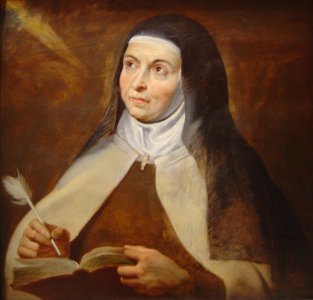
St. Teresa of Avila, 1515 - 1582


"Teresa lived in an age of exploration as well as political, social and religious upheaval. It was the 16th century, a time of turmoil and reform. Her life began with the culmination of the Protestant Reformation, and ended shortly after the Council of Trent.
The gift of God to Teresa in and through which she became holy and left her mark on the Church and the world is threefold: She was a woman; she was a contemplative; she was an active reformer.

As a woman, Teresa stood on her own two feet, even in the man's world of her time. She was "her own woman," entering the Carmelites despite strong opposition from her father. She is a person wrapped not so much in silence as in mystery. Beautiful, talented, outgoing, adaptable, affectionate, courageous, enthusiastic, she was totally human. Like Jesus, she was a mystery of paradoxes: wise, yet practical; intelligent, yet much in tune with her experience; a mystic, yet an energetic reformer. A holy woman, a womanly woman.

Teresa was a woman "for God," a woman of prayer, discipline and compassion. Her heart belonged to God. Her own conversion was no overnight affair; it was an arduous lifelong struggle, involving ongoing purification and suffering. She was misunderstood, misjudged, opposed in her efforts at reform. Yet she struggled on, courageous and faithful; she struggled with her own mediocrity, her illness, her opposition. And in the midst of all this she clung to God in life and in prayer. Her writings on prayer and contemplation are drawn from her experience: powerful, practical and graceful. A woman of prayer; a woman for God.

Teresa was a woman "for others." Though a contemplative, she spent much of her time and energy seeking to reform herself and the Carmelites, to lead them back to the full observance of the primitive Rule. She founded over a half-dozen new monasteries. She traveled, wrote, fought—always to renew, to reform. In her self, in her prayer, in her life, in her efforts to reform, in all the people she touched, she was a woman for others, a woman who inspired and gave life.

In 1970 the Church gave her the title she had long held in the popular mind: Doctor of the Church. She and St. Catherine of Siena were the first women so honored." (From Saint A Day)

Thursday, October 2, 2008

Feast of the Guardian Angels!


Perhaps no aspect of Catholic piety is as comforting to parents as the belief that an angel protects their little ones from dangers real and imagined. Yet guardian angels are not just for children. Their role is to represent individuals before God, to watch over them always, to aid their prayer and to present their souls to God at death.
The concept of an angel assigned to guide and nurture each human being is a development of Catholic doctrine and piety based on Scripture but not directly drawn from it. Jesus' words in Matthew 18:10 best support the belief: "See that you do not despise one of these little ones, for I say to you that their angels in heaven always look upon the face of my heavenly Father."

Devotion to the angels began to develop with the birth of the monastic tradition. St. Benedict gave it impetus and Bernard of Clairvaux, the great 12th-century reformer, was such an eloquent spokesman for the guardian angels that angelic devotion assumed its current form in his day.

A feast in honor of the guardian angels was first observed in the 16th century. In 1615, Pope Paul V added it to the Roman calendar.

(from Saint A Day)

Wednesday, October 1, 2008

St Therese of the Child Jesus


St. Thérèse of the Child Jesus and the Holy Face is one of the Church’s most popular saints. Thérèse was born in 1873 to Louis Martin, a watchmaker, and Zelie Guerin, a lace-maker. She was one of nine children, four of whom died very young. Thérèse suffered greatly in her early life due to the death of her mother, and she endured years of very difficult mental anguish. Thérèse’s faith was strong, and she became a Carmelite nun at the early age of fifteen, after requesting the special permission of her bishop and the pope. She lived in the Carmelite convent of Lisieux, France, joining two of her sisters there. Her other two sisters also became nuns.

Her nine years there seemed uneventful and ordinary, yet were very heroic. Thérèse realized that sanctity could be achieved in and through the simple routines and daily work of life. Instead of ambitiously seeking to do great things, she contented herself with following her “little way” – simple trust in and love for God, and the attempt to glorify Him in everything she did, no matter how insignificant. She considered herself the “little flower,” more ordinary than a rose, unseen by the world, yet beautiful and cherished by God nonetheless.

She once said, “I prefer the monotony of obscure sacrifice to all ecstasies. To pick up a pin for love can convert a soul.” Thérèse suffered from poor health all her life, but, in spite of her frailty, she spent many hours of hard work in the convent laundry and refectory.

During her last year of life, she contracted tuberculosis and suffered greatly before dying at the very young age of twenty-four. (The day of her death she murmured, “I would not suffer less.”) Her Autobiography, written in obedience to her superiors, was later published under the title The Story of a Soul. As she died, she clutched a crucifix, and repeated, “Oh, how I love Him!”

She was canonized a saint, and in 1997 was proclaimed a Doctor of the Church by Pope John Paul II.

(from Catholic Exchange)

Tuesday, September 23, 2008

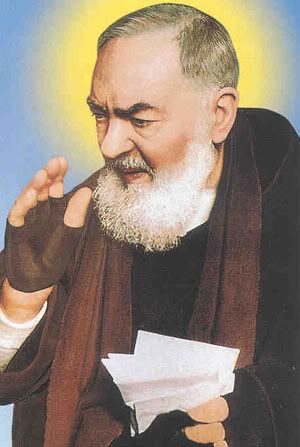
St. Padre Pio


St. Padre Pio da Pietrelcina


(1887-1968)


"In one of the largest such ceremonies in history, Pope John Paul II canonized Padre Pio of Pietrelcina on June 16, 2002. It was the 45th canonization ceremony in Pope John Paul's pontificate. More than 300,000 people braved blistering heat as they filled St. Peter's Square and nearby streets. They heard the Holy Father praise the new saint for his prayer and charity. "This is the most concrete synthesis of Padre Pio's teaching," said the pope. He also stressed Padre Pio's witness to the power of suffering. If accepted with love, the Holy Father stressed, such suffering can lead to "a privileged path of sanctity."
Many people have turned to the Italian Capuchin Franciscan to intercede with God on their behalf; among them was the future Pope John Paul II. In 1962, when he was still an archbishop in Poland, he wrote to Padre Pio and asked him to pray for a Polish woman with throat cancer. Within two weeks, she had been cured of her life-threatening disease.

Born Francesco Forgione, Padre Pio grew up in a family of farmers in southern Italy. Twice (1898-1903 and 1910-17) his father worked in Jamaica, New York, to provide the family income.

At the age of 15, Francesco joined the Capuchins and took the name of Pio. He was ordained in 1910 and was drafted during World War I. After he was discovered to have tuberculosis, he was discharged. In 1917 he was assigned to the friary in San Giovanni Rotondo, 75 miles from the city of Bari on the Adriatic.

On September 20, 1918, as he was making his thanksgiving after Mass, Padre Pio had a vision of Jesus. When the vision ended, he had the stigmata in his hands, feet and side.

Life became more complicated after that. Medical doctors, Church authorities and curiosity seekers came to see Padre Pio. In 1924 and again in 1931, the authenticity of the stigmata was questioned; Padre Pio was not permitted to celebrate Mass publicly or to hear confessions. He did not complain of these decisions, which were soon reversed. However, he wrote no letters after 1924. His only other writing, a pamphlet on the agony of Jesus, was done before 1924.

Padre Pio rarely left the friary after he received the stigmata, but busloads of people soon began coming to see him. Each morning after a 5 a.m. Mass in a crowded church, he heard confessions until noon. He took a mid-morning break to bless the sick and all who came to see him. Every afternoon he also heard confessions. In time his confessional ministry would take 10 hours a day; penitents had to take a number so that the situation could be handled. Many of them have said that Padre Pio knew details of their lives that they had never mentioned... (Continued here)"

Saturday, September 13, 2008

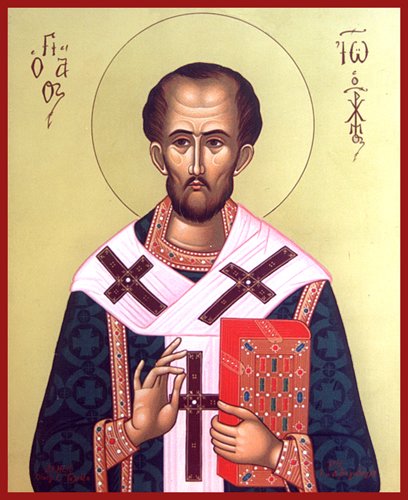
St. John Chrysostom


I have this saint in my saints' book, Catholic Saints Prayer Book.

"The ambiguity and intrigue surrounding John, the great preacher (his name means "golden-mouthed") from Antioch, are characteristic of the life of any great man in a capital city. Brought to Constantinople after a dozen years of priestly service in Syria, John found himself the reluctant victim of an imperial ruse to make him bishop in the greatest city of the empire. Ascetic, unimposing but dignified, and troubled by stomach ailments from his desert days as a monk, John began his episcopate under the cloud of imperial politics.
If his body was weak, his tongue was powerful. The content of his sermons, his exegesis of Scripture, were never without a point. Sometimes the point stung the high and mighty. Some sermons lasted up to two hours.

His life-style at the imperial court was not appreciated by some courtiers. He offered a modest table to episcopal sycophants hanging around for imperial and ecclesiastical favors. John deplored the court protocol that accorded him precedence before the highest state officials. He would not be a kept man.

His zeal led him to decisive action. Bishops who bribed their way into their office were deposed. Many of his sermons called for concrete steps to share wealth with the poor. The rich did not appreciate hearing from John that private property existed because of Adam's fall from grace any more than married men liked to hear that they were bound to marital fidelity just as much as their wives. When it came to justice and charity, John acknowledged no double standards.

Aloof, energetic, outspoken, especially when he became excited in the pulpit, John was a sure target for criticism and personal trouble. He was accused of gorging himself secretly on rich wines and fine foods. His faithfulness as spiritual director to the rich widow, Olympia, provoked much gossip attempting to prove him a hypocrite where wealth and chastity were concerned. His action taken against unworthy bishops in Asia Minor was viewed by other ecclesiastics as a greedy, uncanonical extension of his authority.

Two prominent personages who personally undertook to discredit John were Theophilus, Archbishop of Alexandria, and Empress Eudoxia. Theophilus feared the growth in importance of the Bishop of Constantinople and took occasion to charge John with fostering heresy. Theophilus and other angered bishops were supported by Eudoxia. The empress resented his sermons contrasting gospel values with the excesses of imperial court life. Whether intended or not, sermons mentioning the lurid Jezebel and impious Herodias were associated with the empress, who finally did manage to have John exiled. He died in exile in 407."

(From Saint of the Day)

Friday, September 5, 2008

Blessed Teresa of Calcutta's feast day!


"Jesus is pleased to come to us
As the truth to be told
And the life to be lived,
As the light to be lighted
And love to be loved
As the joy to be given
And the peace to be spread"
--Blessed Teresa of Calcutta

***


Here are two previous radio segments where I speak about Mother TeresaMy book, Prayerfully Expecting and how I met Mother Teresa,

And Addressing the comments in the media about Mother Teresa's supposed "crisis of faith,"