Wednesday, July 22, 2009

Saint Mary Magdalene


"Except for the mother of Jesus, few women are more honored in the Bible than Mary Magdalene. Yet she could well be the patron of the slandered, since there has been a persistent legend in the Church that she is the unnamed sinful woman who anointed the feet of Jesus in Luke 7:36-50.
Most Scripture scholars today point out that there is no scriptural basis for confusing the two women. Mary Magdalene, that is, “of Magdala,” was the one from whom Christ cast out “seven demons” (Luke 8:2)—an indication, at the worst, of extreme demonic possession or, possibly, severe illness.

Father W.J. Harrington, O.P., writing in the New Catholic Commentary, says that “seven demons” “does not mean that Mary had lived an immoral life—a conclusion reached only by means of a mistaken identification with the anonymous woman of Luke 7:36.” Father Edward Mally, S.J., writing in the Jerome Biblical Commentary, agrees that she “is not...the same as the sinner of Luke 7:37, despite the later Western romantic tradition about her.”

Mary Magdalene was one of the many “who were assisting them [Jesus and the Twelve] out of their means.” She was one of those who stood by the cross of Jesus with his mother. And, of all the “official” witnesses that might have been chosen for the first awareness of the Resurrection, she was the one to whom that privilege was given."

From "A Saint A Day" AmericanSaint.Org

Tuesday, July 14, 2009

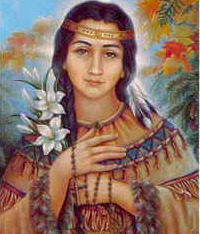
Blessed Kateri Tekawitha


"The blood of martyrs is the seed of saints. Nine years after the Jesuits Isaac Jogues and John de Brébeuf were tortured to death by Huron and Iroquois Indians, a baby girl was born near the place of their martyrdom, Auriesville, New York. She was to be the first person born in North America to be beatified.
Her mother was a Christian Algonquin, taken captive by the Iroquois and given as wife to the chief of the Mohawk clan, the boldest and fiercest of the Five Nations. When she was four, Kateri lost her parents and little brother in a smallpox epidemic that left her disfigured and half blind. She was adopted by an uncle, who succeeded her father as chief. He hated the coming of the Blackrobes (missionaries), but could do nothing to them because a peace treaty with the French required their presence in villages with Christian captives. She was moved by the words of three Blackrobes who lodged with her uncle, but fear of him kept her from seeking instruction. She refused to marry a Mohawk brave and at 19 finally got the courage to take the step of converting. She was baptized with the name Kateri (Catherine) on Easter Sunday.

Now she would be treated as a slave. Because she would not work on Sunday, she received no food that day. Her life in grace grew rapidly. She told a missionary that she often meditated on the great dignity of being baptized. She was powerfully moved by God’s love for human beings and saw the dignity of each of her people.

She was always in danger, for her conversion and holy life created great opposition. On the advice of a priest, she stole away one night and began a 200-mile walking journey to a Christian Indian village at Sault St. Louis, near Montreal.

For three years she grew in holiness under the direction of a priest and an older Iroquois woman, giving herself totally to God in long hours of prayer, in charity and in strenuous penance. At 23 she took a vow of virginity, an unprecedented act for an Indian woman, whose future depended on being married. She foun d a place in the woods where she could pray an hour a day—and was accused of meeting a man there!

Her dedication to virginity was instinctive: She did not know about religious life for women until she visited Montreal. Inspired by this, she and two friends wanted to start a community, but the local priest dissuaded her. She humbly accepted an “ordinary” life. She practiced extremely severe fasting as penance for the conversion of her nation. She died the afternoon before Holy Thursday. Witnesses said that her emaciated face changed color and became like that of a healthy child. The lines of suffering, even the pockmarks, disappeared and the touch of a smile came upon her lips. She was beatified in 1980." (From Catholic Saint. org, Saint A Day)

Monday, June 8, 2009

Pope John Paul II's beatification is drawing near


Rome, Italy, Jun 5, 2009 / 04:18 am (CNA).- Two requirements necessary to beatify Pope John Paul II could be met this year, a former Vatican spokesman has said.

The Congregation for the Causes of Saints must approve a decree recognizing the late pontiff’s “heroic virtues” and certify a miracle attributed to him before he can be declared a blessed. Joaquin Navarro Valls, who was the Vatican spokesman under John Paul II, stated in an interview with “Sole 24 Ore” on Thursday that once the requirements are met, Pope Benedict “at any moment” can set the date to proclaim his beatification.

Navarro-Valls also denied reports that the beatification process had been slowed by Polish psychiatrist Wanda Poltawska’s failure to hand over personal correspondence with John Paul II.

Daniel Ols, the spokesman for John Paul II's cause, did not confirm or deny to ANSA that the beatification could occur in April 2010 on the fifth anniversary of the Pope’s death.

Pope Benedict XVI had waived a requirement of a five-year wait before beginning an investigation into his predecessor’s beatification. New reports of miracles attributed to John Paul II’s intervention are said to arrive in Rome every week.

Monday, June 1, 2009

St. Justin


Today is St. Justin's feast day.

From "Saint of the day":

"Justin never ended his quest for religious truth even when he converted to Christianity after years of studying various pagan philosophies.
As a young man, he was principally attracted to the school of Plato. However, he found that the Christian religion answered the great questions about life and existence better than the philosophers.

Upon his conversion he continued to wear the philosopher's mantle, and became the first Christian philosopher. He combined the Christian religion with the best elements in Greek philosophy. In his view, philosophy was a pedagogue of Christ, an educator that was to lead one to Christ.

Justin is known as an apologist, one who defends in writing the Christian religion against the attacks and misunderstandings of the pagans. Two of his so-called apologies have come down to us; they are addressed to the Roman emperor and to the Senate.

For his staunch adherence to the Christian religion, Justin was beheaded in Rome in 165."

Thursday, April 16, 2009

St. Bernadette


"Bernadette Soubirous was born in 1844, the first child of an extremely poor miller in the town of Lourdes in southern France. The family was living in the basement of a dilapidated building when on February 11,1858, the Blessed Virgin Mary appeared to Bernadette in a cave above the banks of the Gave River near Lourdes. Bernadette, 14 years old, was known as a virtuous girl though a dull student who had not even made her first Holy Communion. In poor health, she had suffered from asthma from an early age.

There were 18 appearances in all, the final one occurring on the feast of Our Lady of Mt. Carmel, July 16. Although Bernadette's initial reports provoked skepticism, her daily visions of "the Lady" brought great crowds of the curious. The Lady, Bernadette explained, had instructed her to have a chapel built on the spot of the visions. There the people were to come to wash in and drink of the water of the spring that had welled up from the very spot where Bernadette had been instructed to dig.

According to Bernadette, the Lady of her visions was a girl of 16 or 17 who wore a white robe with a blue sash. Yellow roses covered her feet, a large rosary was on her right arm. In the vision on March 25 she told Bernadette, "I am the Immaculate Conception." It was only when the words were explained to her that Bernadette came to realize who the Lady was.

Few visions have ever undergone the scrutiny that these appearances of the Immaculate Virgin were subject to. Lourdes became one of the most popular Marian shrines in the world, attracting millions of visitors. Miracles were reported at the shrine and in the waters of the spring. After thorough investigation Church authorities confirmed the authenticity of the apparitions in 1862.

During her life Bernadette suffered much. She was hounded by the public as well as by civic officials until at last she was protected in a convent of nuns. Five years later she petitioned to enter the sisters of Notre Dame. After a period of illness she was able to make the journ ey from Lourdes and enter the novitiate. But within four months of her a rrival she was given the last rites of the Church and allowed to profess her vows. She recovered enough to become infirmarian and then sacristan, but chronic health problems persisted. She died on April 16, 1879, at the age of 35.
She was canonized in 1933." (From A Saint a Day)

I have St. Bernadette in my book, Catholic Saints Prayer Book (OSV, 2008).

Thursday, March 19, 2009

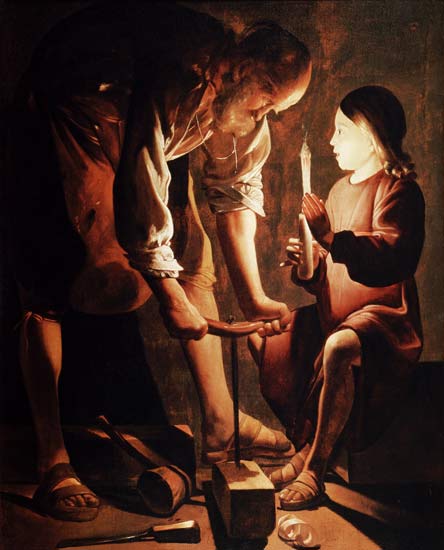
Happy Feast of Saint Joseph!


Have a wonderful feast of St. Joseph! I love him, he's awesome! Of course, he's included in my book, "Catholic Saints Prayer Book" (OSV, 2008).

Here's a prayer from the Roman Missal:

Father, you entrusted our Savior to the care of St. Joseph. By the help of his prayers may your Church continue to serve its Lord, Jesus Christ, who lives and reigns with you and the Holy Spirit, one God for ever and ever. Amen."

Here's an excerpt from my book:

Dear St. Joseph, you were an ordinary man, a humble carpenter. But you were a prayerful, holy soul, the foster father of Jesus, a model for us all. Please guide me in my own journey through life, and help me be aware of God's specific call to me. Help me to see that in my own life God is calling me to greater things for His glory. Please pray to the Blessed Trinity for me to be granted the graces that I need most. I pray that I can be faithful to my state of life, totally trusting in God's divine providence for me. St. Joseph, pray for all who invoke your aid. If it is in God's holy will, please grant me (here mention your request). Amen.

Have a very BLESSED feast day!

Donna-Marie

Tuesday, March 17, 2009

Happy St. Patrick's Day!

"Christ shield me this day: Christ with me, Christ before me, Christ behind me, Christ in me, Christ beneath me, Christ above me, Christ on my right, Christ on my left, Christ when I lie down, Christ when I arise, Christ in the heart of every person who thinks of me, Christ in the eye that sees me, Christ in the ear that hears me."~St. Patrick

Wednesday, January 28, 2009

St Thomas Aquinas

"Whoever wishes to live perfectly should do nothing but disdain what Christ disdained on the cross and desire what he desired, for the cross exemplifies every virtue."

St. Thomas Aquinas

Saturday, January 24, 2009

St Francis de Sales


Feast of St. Francis de Sales, Bishop and Doctor (1567 - 1622)

"Our business is to love what God would have done. He wills our vocation as it is. Let us love that and not trifle away our time hankering after other people's vocations."

St. Francis de Sales

He also said:

"God is in all things and all places. There is no place or thing in this world where he is not truly present. Just as wherever birds fly they always encounter the air, so also wherever we go or wherever we are we find God present. Everyone knows this truth but everyone does not try to bring it home to himself. Blind men do not see a prince who is present among them, and therefore do not show him the respect they do after being told of his presence. However, because they do not actually see him they easily forget his presence, and having forgotten it, they still more easily lose the respect and reverence owed to him. Unfortunately, Philothes, we do not see God who is present with us. Although faith assures us of his presence, yet because we do not see him with our eyes we often forget about him and behave as if God were far distant from us. We really know tht he is present in all things, but because we do not reflect on that fact we act as if we did not know it. This is why before praying we must always arouse our souls to explicit thought and consideration of God's presence."


-- ST. Francis de Sales, "Introduction to the Devout Life"