
Showing posts with label Daily Donna-Marie. Show all posts
Showing posts with label Daily Donna-Marie. Show all posts
Saturday, November 1, 2008


Thursday, October 2, 2008
Feast of the Guardian Angels!

Perhaps no aspect of Catholic piety is as comforting to parents as the belief that an angel protects their little ones from dangers real and imagined. Yet guardian angels are not just for children. Their role is to represent individuals before God, to watch over them always, to aid their prayer and to present their souls to God at death.
The concept of an angel assigned to guide and nurture each human being is a development of Catholic doctrine and piety based on Scripture but not directly drawn from it. Jesus' words in Matthew 18:10 best support the belief: "See that you do not despise one of these little ones, for I say to you that their angels in heaven always look upon the face of my heavenly Father."
Devotion to the angels began to develop with the birth of the monastic tradition. St. Benedict gave it impetus and Bernard of Clairvaux, the great 12th-century reformer, was such an eloquent spokesman for the guardian angels that angelic devotion assumed its current form in his day.
A feast in honor of the guardian angels was first observed in the 16th century. In 1615, Pope Paul V added it to the Roman calendar.
(from Saint A Day)
Wednesday, October 1, 2008
St Therese of the Child Jesus

St. Thérèse of the Child Jesus and the Holy Face is one of the Church’s most popular saints. Thérèse was born in 1873 to Louis Martin, a watchmaker, and Zelie Guerin, a lace-maker. She was one of nine children, four of whom died very young. Thérèse suffered greatly in her early life due to the death of her mother, and she endured years of very difficult mental anguish. Thérèse’s faith was strong, and she became a Carmelite nun at the early age of fifteen, after requesting the special permission of her bishop and the pope. She lived in the Carmelite convent of Lisieux, France, joining two of her sisters there. Her other two sisters also became nuns.
Her nine years there seemed uneventful and ordinary, yet were very heroic. Thérèse realized that sanctity could be achieved in and through the simple routines and daily work of life. Instead of ambitiously seeking to do great things, she contented herself with following her “little way” – simple trust in and love for God, and the attempt to glorify Him in everything she did, no matter how insignificant. She considered herself the “little flower,” more ordinary than a rose, unseen by the world, yet beautiful and cherished by God nonetheless.
She once said, “I prefer the monotony of obscure sacrifice to all ecstasies. To pick up a pin for love can convert a soul.” Thérèse suffered from poor health all her life, but, in spite of her frailty, she spent many hours of hard work in the convent laundry and refectory.
During her last year of life, she contracted tuberculosis and suffered greatly before dying at the very young age of twenty-four. (The day of her death she murmured, “I would not suffer less.”) Her Autobiography, written in obedience to her superiors, was later published under the title The Story of a Soul. As she died, she clutched a crucifix, and repeated, “Oh, how I love Him!”
She was canonized a saint, and in 1997 was proclaimed a Doctor of the Church by Pope John Paul II.
(from Catholic Exchange)
Tuesday, September 23, 2008
St. Padre Pio
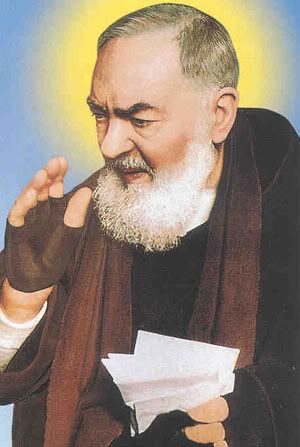
"In one of the largest such ceremonies in history, Pope John Paul II canonized Padre Pio of Pietrelcina on June 16, 2002. It was the 45th canonization ceremony in Pope John Paul's pontificate. More than 300,000 people braved blistering heat as they filled St. Peter's Square and nearby streets. They heard the Holy Father praise the new saint for his prayer and charity. "This is the most concrete synthesis of Padre Pio's teaching," said the pope. He also stressed Padre Pio's witness to the power of suffering. If accepted with love, the Holy Father stressed, such suffering can lead to "a privileged path of sanctity."
Many people have turned to the Italian Capuchin Franciscan to intercede with God on their behalf; among them was the future Pope John Paul II. In 1962, when he was still an archbishop in Poland, he wrote to Padre Pio and asked him to pray for a Polish woman with throat cancer. Within two weeks, she had been cured of her life-threatening disease.
Born Francesco Forgione, Padre Pio grew up in a family of farmers in southern Italy. Twice (1898-1903 and 1910-17) his father worked in Jamaica, New York, to provide the family income.
At the age of 15, Francesco joined the Capuchins and took the name of Pio. He was ordained in 1910 and was drafted during World War I. After he was discovered to have tuberculosis, he was discharged. In 1917 he was assigned to the friary in San Giovanni Rotondo, 75 miles from the city of Bari on the Adriatic.
On September 20, 1918, as he was making his thanksgiving after Mass, Padre Pio had a vision of Jesus. When the vision ended, he had the stigmata in his hands, feet and side.
Life became more complicated after that. Medical doctors, Church authorities and curiosity seekers came to see Padre Pio. In 1924 and again in 1931, the authenticity of the stigmata was questioned; Padre Pio was not permitted to celebrate Mass publicly or to hear confessions. He did not complain of these decisions, which were soon reversed. However, he wrote no letters after 1924. His only other writing, a pamphlet on the agony of Jesus, was done before 1924.
Padre Pio rarely left the friary after he received the stigmata, but busloads of people soon began coming to see him. Each morning after a 5 a.m. Mass in a crowded church, he heard confessions until noon. He took a mid-morning break to bless the sick and all who came to see him. Every afternoon he also heard confessions. In time his confessional ministry would take 10 hours a day; penitents had to take a number so that the situation could be handled. Many of them have said that Padre Pio knew details of their lives that they had never mentioned... (Continued here)"
Saturday, September 13, 2008
St. John Chrysostom
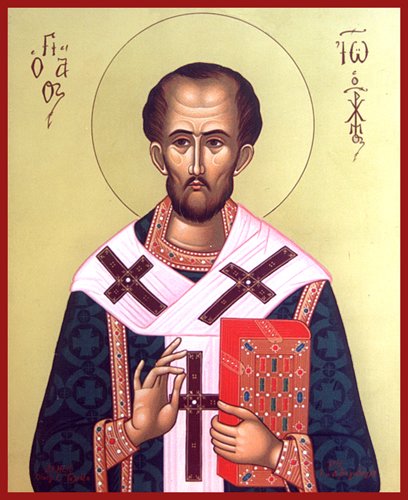
I have this saint in my saints' book, Catholic Saints Prayer Book.
"The ambiguity and intrigue surrounding John, the great preacher (his name means "golden-mouthed") from Antioch, are characteristic of the life of any great man in a capital city. Brought to Constantinople after a dozen years of priestly service in Syria, John found himself the reluctant victim of an imperial ruse to make him bishop in the greatest city of the empire. Ascetic, unimposing but dignified, and troubled by stomach ailments from his desert days as a monk, John began his episcopate under the cloud of imperial politics.
If his body was weak, his tongue was powerful. The content of his sermons, his exegesis of Scripture, were never without a point. Sometimes the point stung the high and mighty. Some sermons lasted up to two hours.
His life-style at the imperial court was not appreciated by some courtiers. He offered a modest table to episcopal sycophants hanging around for imperial and ecclesiastical favors. John deplored the court protocol that accorded him precedence before the highest state officials. He would not be a kept man.
His zeal led him to decisive action. Bishops who bribed their way into their office were deposed. Many of his sermons called for concrete steps to share wealth with the poor. The rich did not appreciate hearing from John that private property existed because of Adam's fall from grace any more than married men liked to hear that they were bound to marital fidelity just as much as their wives. When it came to justice and charity, John acknowledged no double standards.
Aloof, energetic, outspoken, especially when he became excited in the pulpit, John was a sure target for criticism and personal trouble. He was accused of gorging himself secretly on rich wines and fine foods. His faithfulness as spiritual director to the rich widow, Olympia, provoked much gossip attempting to prove him a hypocrite where wealth and chastity were concerned. His action taken against unworthy bishops in Asia Minor was viewed by other ecclesiastics as a greedy, uncanonical extension of his authority.
Two prominent personages who personally undertook to discredit John were Theophilus, Archbishop of Alexandria, and Empress Eudoxia. Theophilus feared the growth in importance of the Bishop of Constantinople and took occasion to charge John with fostering heresy. Theophilus and other angered bishops were supported by Eudoxia. The empress resented his sermons contrasting gospel values with the excesses of imperial court life. Whether intended or not, sermons mentioning the lurid Jezebel and impious Herodias were associated with the empress, who finally did manage to have John exiled. He died in exile in 407."
(From Saint of the Day)
Friday, September 5, 2008
Blessed Teresa of Calcutta's feast day!

As the truth to be told
And the life to be lived,
As the light to be lighted
And love to be loved
As the joy to be given
And the peace to be spread"
Here are two previous radio segments where I speak about Mother TeresaMy book, Prayerfully Expecting and how I met Mother Teresa,
And Addressing the comments in the media about Mother Teresa's supposed "crisis of faith,"
Monday, September 1, 2008
Labor day with St. Joseph the worker
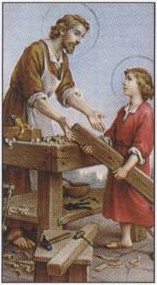
A Prayer for Workers
O glorious Joseph! Who concealed your incomparable and regal dignity of custodian of Jesus and of the Virgin Mary under the humble appearance of a craftsman and provided for them with your work, protect with loving power your sons, especially entrusted to you.
You know their anxieties and sufferings, because you yourself experienced them at the side of Jesus and of His Mother. Do not allow them, oppressed by so many worries, to forget the purpose for which they were created by God. Do not allow the seeds of distrust to take hold of their immortal souls. Remind all the workers that in the fields, in factories, in mines, and in scientific laboratories, they are not working, rejoicing, or suffering alone, but at their side is Jesus, with Mary, His Mother and ours, to sustain them, to dry the sweat of their brow, giving value to their toil. Teach them to turn work into a very high instrument of sanctification as you did. Amen.
[composed by Blessed Pope John XXIII (1958-63)]
Thursday, August 28, 2008
St. Augustine

"A Christian at 33, a priest at 36, a bishop at 41: many people are familiar with the biographical sketch of Augustine of Hippo, sinner turned saint. But really to get to know the man is a rewarding experience.
There quickly surfaces the intensity with which he lived his life, whether his path led away from or toward God. The tears of his mother, the instructions of Ambrose and, most of all, God himself speaking to him in the Scriptures redirected Augustine’s love of life to a life of love.
Having been so deeply immersed in creature-pride of life in his early days and having drunk deeply of its bitter dregs, it is not surprising that Augustine should have turned, with a holy fierceness, against the many demon-thrusts rampant in his day. His times were truly decadent—politically, socially, morally. He was both feared and loved, like the Master. The perennial criticism leveled against him: a fundamental rigorism.
In his day, he providentially fulfilled the office of prophet. Like Jeremiah and other greats, he was hard-pressed but could not keep quiet. “I say to myself, I will not mention him,/I will speak in his name no more./But then it becomes like fire burning in my heart,/imprisoned in my bones;/I grow weary holding it in,/I cannot endure it” (Jeremiah 20:9)." From "Saint A Day."
Wednesday, August 27, 2008
St. Monica

Being a mother, one of my favorite saints is St. Monica. I admire her for her unceasing prayer for her wayward son and her husband. St. Monica's prayers, by God's grace changed hearts. Her tears were redemptive and her prayers powerful. Every faithful mother's prayer is powerful. We need to believe that the words that were spoken to St. Monica by her Bishop when she pleaded through tears for help from him for her wayward son, Augustine are words that are meant for every faithful Christian mother. We must believe, trust, and never give up on hope!
From my new book, Catholic Saints Prayer Book:
Dear St. Monica, your devotion as a mother and wife and your commitment to your family, especially in your prayer for them, sets a powerful and timely example for us all. Please pray to the Blessed Trinity for me, my family, and all I hold dear so that we will be open to the graces that Our Lord in His great mercy wants to shed upon us. Help mothers and wives everywhere to know that Our Lord never turns His ear away from a mother's faithful prayers for her family. St. Monica, pray for us and for all who invoke your aid. If it is in God's holy will, please grant me (here mention your request). Amen.
From Fr. James's blog:
"Saint Monica (331-387) was the mother of one of the most celebrated converts in the history of the Catholic Church. Augustine was spiritually lost for many years and his mother shed many tears. St. Ambrose was approached one day by Monica after Mass with tears in her eyes begging the the famous bishop of Milan that he pray for the conversion of her son. "God will never deny the tears of a mother", were his consoling words to the troubled mother of the wayward son. Eventually Augustine did leave behind his life of sin and was baptized. Moreover, he became a priest and then a bishop. He is known was one of the most famous theologians of the Catholic Church.
I have been a Catholic priest for almost 21 years. Almost every family that I have known as a priest has worries and concerns about wayward children that have lost the Faith or are living immoral lives. Like Ambrose, I have seen many tears shed by many mothers and even many fathers. Parents must look to the example of St. Monica and never give up on their wayward children. Let us remember our best weapons for the conversion of sinners: prayer and penance. I am sure that Monica's struggle with Augustine gave her plenty of opportunities to become the great saint that she became."
Sunday, August 24, 2008
St Rose of Lima

Yesterday was the feast of St. Rose of Lima
From the writings of St. Rose of Lima:
"Our Lord and Savior lifted up his voice and said with incomparable majesty: 'Let all men know that grace comes after tribulation. Let them know that without the burden of afflictions it is impossible to reach the height of grace. Let them know that the gifts of grace increase as the struggles increase. Let men take care not to stray and be deceived. This is the only true stairway to paradise, and without the cross they can find no road to climb to heaven.'
When I heard these words, a strong force came upon me and seemed to place me in the middle of a street, so that I might say in a loud voice to people of every age, sex and status: "Hear, O people; hear, O nations. I am warning you about the commandment of Christ by using words that came from his own lips: We cannot obtain grace unless we suffer afflictions. We must heap trouble upon trouble to attain a deep participation in the divine nature, the glory of the sons of God and perfect happiness lf soul."
That same force strongly urged me to proclaim the beauty of divine grace. It pressed me so that my breath came slow and forced me to sweat and pant. I felt as if my soul could no longer be kept in the prison of the body, but that it had burst its chains and was free and alone and was going very swiftly through the whole world saying: 'If only mortals would learn how great it is to possess divine grace, how beautiful, how noble, how precious. How many riches it hides within itself, how many joys and delights! Without doubt they would devote all their care and concern to winning for themselves pains and afflictions. All men throughout the world would seek trouble, infirmities and torments, instead of good fortune, in order to attain the unfathomable treasure of grace. This is the reward and the final gain of patience. No one would complain about his cross or about troubles that may happen to him, if he would come to know the scales on which they are weighed when they are distributed to men.'"
HT to Fr. James
Friday, August 22, 2008
The Queenship of Mary

"Pius XII established this feast in 1954. But Mary’s queenship has roots in Scripture. At the Annunciation Gabriel announced that Mary’s Son would receive the throne of David and rule forever. At the Visitation, Elizabeth calls Mary “mother of my Lord.” As in all the mysteries of Mary’s life, Mary is closely associated with Jesus: Her queenship is a share in Jesus’ kingship. We can also recall that in the Old Testament the mother of the king has great influence in court.
In the fourth century St. Ephrem called Mary “Lady” and “Queen” and Church Fathers and Doctors continued to use the title. Hymns of the eleventh to thirteenth centuries address Mary as queen: “Hail, Holy Queen,” “Hail, Queen of Heaven,” “Queen of Heaven.” The Dominican rosary and the Franciscan crown as well as numerous invocations in Mary’s litany celebrate her queenship.
The feast is a logical follow-up to the Assumption and is now celebrated on the octave day of that feast. In his encyclical To the Queen of Heaven, Pius XII points out that Mary deserves the title because she is Mother of God, because she is closely associated as the New Eve with Jesus’ redemptive work, because of her preeminent perfection and because of her intercessory power" (from "Saint a Day").
Monday, August 4, 2008
Review: Catholic Saints Prayer Book

This is from "Building the Ark"
"As much as I loved Donna-Marie Cooper O'Boyle's first book, I wondered if the second book could be as inspiring and engaging. Well, I am happy to report that this gifted mother and writer did not disappoint!
Again, the size and succinctness of the Catholic Saints Prayer Book is a big plus in this busy mom's life. In the midst of my day, if I'm looking for a quick biography of one of the many well-loved and well-known saints, I can easily find it in her book.
It's a little like having an address book for the soul. At a moment's notice, a quick glance down the table of contents is all you need to find the page number of the saint you want to *call*. (Oh, if only there really were phone numbers! ) Then, with her beautiful written prose, a prayer for calling on each saint for intercession.
And being a wee bit biased on all things Irish, I was thrilled to find both the male patron of Ireland--St. Patrick and his not-as-well-known female counterpart St. Brigid. This is a wonderful book to keep in a classroom or family prayer area, in your pocketbook for easy access or to loan out to a friend. Just a warning, though, if you decide to lend it out; buy a second one as a back-up because it may be a while before your friend is ready to give it and all its beauty back!
Thanks again, Donna-Marie! It's always a pleasure!"
Thank you very much, Jane for your very kind words. I'm glad that you are enjoying this book!
God bless and hugs,
Donna-Marie
Friday, August 1, 2008
Miracle in Chili attributed to Nicola D'Onofrio?
Santiago, Aug 1, 2008 / 10:23 am (CNA).- Maria Mercedes Correa Maldonado, a 23 year-old Chilean woman who in explicably “woke up” from cerebral palsy when she was 18, is now pregnant, in what could be the second miracle attributed to Italian seminarian Nicola D’Onofrio (1943-1964), whose cause of beatification is open in the Diocese of Rome.
Maria Mercedes suffered from grave cerebral palsy but on a March afternoon on 2003, after her mother had incessantly prayed to the Italian seminarian for his intercession, she woke up in her hospital bed in Puataendo, sat up and said, “I’m hungry.”
Inexplicable from a medical point of view, the case drew the attention of the Sons of St. Camillus, who are following D’Onofrio’s beatification process in Rome, which began in 2000.
Now, five years after her miraculous recovery, Maria Mercedes says she is experiencing a new miracle from D’Onofrio, as she has become pregnant despite doctors’ diagnoses that it would be impossible. “All the specialists who examined her came to the conclusion that she could never have any children. But now she is pregnant. It is a new miracle,” her mother said... (Continued here).
Maria Mercedes suffered from grave cerebral palsy but on a March afternoon on 2003, after her mother had incessantly prayed to the Italian seminarian for his intercession, she woke up in her hospital bed in Puataendo, sat up and said, “I’m hungry.”
Inexplicable from a medical point of view, the case drew the attention of the Sons of St. Camillus, who are following D’Onofrio’s beatification process in Rome, which began in 2000.
Now, five years after her miraculous recovery, Maria Mercedes says she is experiencing a new miracle from D’Onofrio, as she has become pregnant despite doctors’ diagnoses that it would be impossible. “All the specialists who examined her came to the conclusion that she could never have any children. But now she is pregnant. It is a new miracle,” her mother said... (Continued here).
Tuesday, July 29, 2008
St. Martha

"Martha was born of noble and wealthy parents, but she is still more illustrious for the hospitality she gave to Christ our Lord. After His Ascension into heaven, she was seized by the Jews, together with her brother and sister, Marcella her handmaid, and Maximin, one of the seventy two disciples of our Lord, who had baptized the whole family, and many other Christians. They were put on board a ship without sails or oars, and left helpless on the open sea, exposed to certain shipwreck. But God guided the ship, and they all arrived safely at Marseilles.
This miracle, together with their preaching, brought the people of Marseilles, of Aix, and of the neighborhood to believe in Christ. Lazarus was made Bishop of Marseilles and Maximin of Aix. Magdalen, who was accustomed to devote herself to prayer and to sit at our Lord's feet, in order to enjoy the better part which she had chosen, that is, contemplation of the joys of heaven, retired into a deserted cave on a very high mountain. There she lived for thirty years, separated from all human intercourse; and every day she was carried to heaven by the angels to hear their songs of praise.
But Martha, after having won the love and admiration of the people of Marseilles by the sanctity of her life and her wonderful charity, withdrew in the company of several virtuous women to a spot remote from men, where she lived for a long time, greatly renowned for her piety and prudence. She foretold her death long before it occurred; and at length, famous for miracles, she passed to our Lord on the fourth of the Kalends of August. Her body which lies at Tarascon is held in great veneration."
Excerpted from The Liturgical Year, Abbot Gueranger O.S.B.

"He Knows My Name" blogspot expresses this about St. Martha:
"She is mentioned three times in the Bible, but most people focus on only one - when Jesus was visiting and she wanted His help in getting her sister Mary off the floor to help do the dishes. Our gracious Lord reminded her that it was a good thing to sit awhile and listen, after all they may not get that opportunity again. It doesn't tell us how she responded to that, but if you read further about her I think you'll agree that she would have taken that to heart and learnt from it. In fact, she seemed a very focused woman. She did not appear to be an emotional personality like her sister, but rather seeing things in black and white. She saw there was work to do and set about doing it believing it to be necessary at that time, though Christ teaches her otherwise. Also, she wasn't complaining about working, just that Mary also had chores to do.
Further on, Lazarus has died. Mary is a mess. When Jesus arrives, days after they had sent word to Him, Martha rebukes Him. "Lord, if you had been here my brother would not have died." She doesn't hold back, BUT, can you see what else she is saying? She BELIEVES, without a doubt,that Christ has the power to heal her brother. No faltering faith for Martha. She is convinced (remember, I said she sees everything in black and white?).
Now, if that faith statement doesn't grab you the next one must!
She continues, without taking a breath, "BUT EVEN NOW, I KNOW THAT WHATEVER YOU ASK OF GOD, GOD WILL GIVE YOU." What a woman of faith in her Lord!!
She continues on declaring Him to be "...the Christ, the Son of God..."!"
Wednesday, July 23, 2008
St. Bridget of Sweden

Bridget was born in Sweden in 1303. From the time she was a child, she was greatly devoted to the passion of Jesus. When she was only ten, she seemed to see Jesus on the cross and hear him say, "Look at me, my daughter." "Who has treated you like this?" cried little Bridget. "They who despise me and refuse my love for them," answered Jesus. From then on, Bridget tried to stop people from offending Jesus. When she was fourteen, she married eighteen-year-old Ulf. Like Bridget, Ulf had set his heart on serving God. They had eight children, of whom one was St. Catherine of Sweden. Bridget and Ulf served the Swedish court. Bridget was the queen's personal maid. Bridget tried to help King Magnus and Queen Blanche lead better lives. For the most part, they did not listen to her. All her life, Bridget had marvelous visions and received special messages from God. In obedience to them, she visited many rulers and important people in the Church. She explained humbly what God expected of them. After her husband died, Bridget put away her rich clothes. She lived as a poor nun. Later, she started the order of the Most Holy Savior, also known as Bridgettines. She still kept up her own busy life, traveling about doing good everywhere. And through all this activity, Jesus continued to reveal many secrets to her. These she received without the least bit of pride. Shortly before she died, the saint went on a pilgrimage to the Holy Land. At the shrines there, she had visions of what Jesus had said and done in that place. All St. Bridget's revelations on the sufferings of Jesus were published after her death. St. Bridget died in Rome on July 23, 1373. She was proclaimed a saint by Pope Boniface IX in 1391. May Jesus Christ, the Redeemer of the world, grant us the grace to share in his passion through a deeper spirit of repentance. (From Saint of the Day)
Tuesday, July 22, 2008
Review from Hawaii on my book "Catholic Saints Prayer Book"

Our family's home is filled with Catholic books, especially books on the saints. Would there be new book on the saints that would stand out? Could there really be a Catholic saints book that would be different than the ones already sitting on our book shelves?
Well, when fellow Catholic blogger and online friend Donna-Marie Cooper O'Boyle gave me an opportunity to read and review her book, I was briefly hesitant to accept because I believed that it would just be another ordinary saints book.
However, after reading Donna's little book recently published by Our Sunday Visitor I can honestly say that this book truly stands out.
First of all, you can see it was a work of love on Donna's part. Here is a woman who is very spiritual and who has been blessed in her life to personally know a Catholic saint, Mother Teresa of Calcutta.
Then there is the fact that the book in itself is beautiful to behold. It reminded me of the old fashioned books with the lovely designs and elegant fonts. It was not a cheap paperback but a quality hardcover book.
The book itself is tiny in size yet packed full of interesting tidbits of favorite Catholic saints. Some of my favorite saints which I found covered in the book include:
- St. Augustine
- St. Faustina
- St. Francis
- St. John Chrysostom
- St. Maximilian Kolbe
- St. Padre Pio
- St. Rita of Cascia
- St. Thomas More
Actually, it was very enjoyable reading about all the saints that were selected by Donna. I believe I learned something new on just about all the saints that I had not known before. For example, I did not know that St. Augustine started living with a woman at the age of fifteen! I also did not know that the sisters of St. Bernadette's convent treated her so harshly!!
Each saint's page contains the feast day of that particular saint, a quote from either the saint, the Catechism of the Catholic Church or from scripture, a short list of all their patronages, (what they were patron saints of)a compact yet precise outline of the saint's biography and to make each entry special, Donna included a prayer for each particular saint. The little book also contains graphics that are not usually seen. For instance, St. Ignatius of Loyola's death mask.
The first time I opened the book to read it was when my family and I were at the airport waiting for my niece and nephew to arrive. I took out the little book to read and was soon absorbed in it. Before I knew it, my husband was looking over my shoulder to read along with me and then soon our son was doing the same thing. In order to be fair we took turns reading the lovely little saints book. My husband commented that that I should always carry the book in my purse. He said it was a treasure. I thought that was an excellent suggestion and so that is what I have been doing since receiving the book.
I really hope that if you are looking for a book on the saints that will captivate your family's interest and also be a prayer book for yourself, that you will consider buying this beautiful little book.
Mahalo Donna for the opportunity to read your new book.
Thank you very much, Esther! Your words are very kind and your review is thorough. Someday I'd love to visit with you in Hawaii!
God bless and hugs,
Donna-Marie
PS Esther has a very beautiful Catholic blog from Hawaii. Go take a look at her Hawaiian Catholic blog, "A Catholic Mom in Hawaii" here!
Thursday, July 17, 2008
Review of Catholic Saints Prayer Book

Mary Rose at True Confessions of a Prodigal Daughter just posted a beautiful review about my saints' book. I think you'll find it interesting how she came to love the saints. Perhaps some of you can relate. Her review is here:
I've had the pleasure of meeting Donna-Marie Cooper O'Boyle online and have been touched by her dedication to encouraging women and celebrating overall her Catholic faith. She is a humble lady, simply wanting to share her love for God with everyone she meets. I can't fathom how she finds time to write since she has five wonderful kids and a husband. Talk about busy!
She sent me her book, Catholic Saints Prayer Book. It is a beautiful small volume, perfect for giving to a teacher or even your college-bound sons and daughters. (Giving college kids anything about saints is an excellent idea.)

The hardbound book is beautifully designed, with a lovely painting on the cover and illustrations inside. The pages are a soft gloss, with a calming green decorative border on the edges of each page. Donna-Marie managed to concisely capture the birth and death dates for each saint, their Feast Day, the saint's patronage, information about their life, and a prayer to that particular saint. Here is one of my favorites:
Prayer to St. Joseph
Dear St. Joseph, you were an ordinary man, a humble carpenter. But you were a prayerful, holy soul, the foster father of Jesus, a model for us all. Please guide me in my own journey through life, and help me be aware of God's specific call to me. Help me to see that in my own life God is calling me to greater things for His glory. Please pray to the Blessed Trinity for me to be granted the graces that I need most. I pray that I can be faithful to my state of life, totally trusting in God's divine providence for me. St. Joseph, pray for all who invoke your aid. If it is in God's holy will, please grant me (here mention your request). Amen.
Isn't that wonderful? I just love this little book of the saints.
I have to admit, appreciating the saints has taken some time. I have witnessed years of anti-Catholic perspectives. One of the biggest gripes Protestants and non-denominational believers have with Catholics is their presumed "praying to the saints." For years, I would declare, "There is no mediator between God and man but Jesus Christ." Of course, no one else could have redeemed us but Jesus Christ. No other sacrifice would do but a perfect one and Jesus Christ was the only one qualified to do it. He was, is, and shall be forever perfect, loving His heavenly Father with perfection, doing His will with complete surrender. No one can or should ever take the place of Jesus Christ.
However, I think my non-Catholic brothers and sisters misunderstand what is going on when Catholics venerate the saints. When prayers are offered up (I am partial to the very brief, "Pray for me, St. Joseph!") I am not worshipping St. Joseph, but asking St. Joseph to count me in his prayers and supplications before the throne of God.
Hebrews 12:1,2 says:
Therefore, since we are surrounded by so great a cloud of witnesses, let us also lay aside every weight, and sin which clings so closely, and let us run with perseverance the race that is set before us, looking to Jesus the pioneer and perfecter of our faith, who for the joy that was set before him endured the cross, despising the shame, and is seated at the right hand of the throne of God. (RSV)
You know, I've read those verses many, many times. I just thought the witnesses watched. But who could watch a race and not cheer? St. Paul was telling the Jewish believers that they had support. These verses took on fresh meaning as I realized those who have gone before us are now in heaven, praying for the Church to be perfected. Doesn't that make sense?
Aren't we asking the saints to put in a few prayers on our behalf that we would be made worthy of the promises of Christ? Of course. I still worship Jesus Christ for who He is and petition our Heavenly Father for all things. Scripture also tells us that the Holy Spirit makes intercession for us:
Likewise the Spirit helps us in our weakness; for we do not know how to pray as we ought, but the Spirit himself intercedes for us with sighs too deep for words. And he who searches the hearts of men knows what is the mind of the Spirit, because the Spirit intercedes for the saints according to the will of God. (Rom. 8:26, 27 RSV)
Ever since I've started to embrace the saints more, I have felt a new confidence enter my faith. I feel as though I do have a huge group of saints who are pulling for me. They know how difficult the journey can be and they are praying that we can overcome our trials and tribulations.
Donna-Marie's Catholic Saint Prayer Book is the perfect way to encourage others that they also have a group of saints who are "pulling for them" to persevere. It's a great gift for either yourself or someone you love. Enjoy it and be blessed! Click on the title to order.
(The above photos are from Mary Rose's blog)
Monday, July 14, 2008
Blessed Kateri Tekawitha

Kateri was born in 1656 near the town of Auriesville, New York, the daughter of a Mohawk warrior. She was baptized by Jesuit missionary Fr. Jacques de Lambertville on Easter of 1676 at the age of twenty. She devoted her life to prayer, penitential practices, and the care of the sick and aged in Caughnawaga near Montreal (where her relics are now enshrined). She incurred the hostility of her tribe because of her faith. She was devoted to the Eucharist, and to Jesus Crucified, and was called the "Lily of the Mohawks." She died in 1680 and was beatified June 22, 1980 — the first native American to be declared "Blessed." — Magnificat, July 2003
According to the 1962 Missal of Bl. John XXIII the Extraordinary Form of the Roman Rite, today is the feast of St. Bonaventure. His feast in the Ordinary Form of the Roman Rite is celebrated on July 15. (From Catholic Culture)
More from Catholic Culture:
Bl. Kateri Tekakwitha
[Pronounce: Gah-deh-lee Deh-gah-quee-tah]
The blood of martyrs is the seed of saints. Nine years after the Jesuits Isaac Jogues and John de Brebeuf were tortured to death by Huron and Iroquois Native American nations, a baby girl was born near the place of their martyrdom, Auriesville, New York. She was to be the first person born in North America to be beatified. Her mother was a Christian Algonquin, taken captive by the Iroquois and given as wife to the chief of the Mohawk clan, the boldest and fiercest of the Five Nations. When she was four, Kateri lost her parents and little brother in a smallpox epidemic that left her disfigured and half blind. She was adopted by an uncle, who succeeded her father as chief. He hated the coming of the Blackrobes (missionaries), but could do nothing to them because a peace treaty with the French required their presence in villages with Christian captives. She was moved by the words of three Blackrobes who lodged with her uncle, but fear of him kept her from seeking instruction. She refused to marry a Mohawk man and at nineteen finally got the courage to take the step of converting. She was baptized with the name Kateri (Catherine) on Easter Sunday... (Continued here)
Pier Giorgio Frassati, a Saint in Waiting
According to News.Com.au:
"THE body of an inspirational Catholic who died in 1925 has arrived in Sydney for World Youth Day.
The body of Pier Giorgio Frassati, who was beatified in 1990 by Pope John Paul II, has been transported from the Turin Cathedral to Sydney following a farewell mass.
Mr Frassati was only 24 when, after a one-week illness, he died of polio.
He became a role model for young Catholics because of his fervent faith and sunny nature and was noted for his charity.
At his funeral the poor turned out in force, beginning a devotion that has spread around the world.
On Wednesday at 12pm (AEST) his body will be transported to St Benedict's Church in Chippendale in inner Sydney where it will remain in the church for veneration until July 10.
The following Thursday his body will be moved to St Mary's Cathedral for a pilgrimage.
The coffin will remain on display in the cathedral until July 22.
The transportation of his remains was organised by Sydney Archbishop George Pell and World Youth Day co-ordinator Bishop Anthony Fisher in conjunction with the Vatican Council for the Causes of Saints.
A possible road to sainthood has been propelled by a vigorous campaign by Mr Frassati's sister, Luciana, who wrote books about him.
It is the first time the body of Mr Frassati has visited Australia."
"THE body of an inspirational Catholic who died in 1925 has arrived in Sydney for World Youth Day.
The body of Pier Giorgio Frassati, who was beatified in 1990 by Pope John Paul II, has been transported from the Turin Cathedral to Sydney following a farewell mass.
Mr Frassati was only 24 when, after a one-week illness, he died of polio.
He became a role model for young Catholics because of his fervent faith and sunny nature and was noted for his charity.
At his funeral the poor turned out in force, beginning a devotion that has spread around the world.
On Wednesday at 12pm (AEST) his body will be transported to St Benedict's Church in Chippendale in inner Sydney where it will remain in the church for veneration until July 10.
The following Thursday his body will be moved to St Mary's Cathedral for a pilgrimage.
The coffin will remain on display in the cathedral until July 22.
The transportation of his remains was organised by Sydney Archbishop George Pell and World Youth Day co-ordinator Bishop Anthony Fisher in conjunction with the Vatican Council for the Causes of Saints.
A possible road to sainthood has been propelled by a vigorous campaign by Mr Frassati's sister, Luciana, who wrote books about him.
It is the first time the body of Mr Frassati has visited Australia."
Wednesday, July 9, 2008
Vatican moving forward on Fr. Damien and Parents of St. Therese

Vatican City, Jul 3, 2008 / 10:50 am (CNA).- The head of the Congregation for the Causes of the Saints, Cardinal Jose Saraiva Martins, met with Pope Benedict today to present him with 14 causes for canonization in their various stages. Among those approved for advancement towards sainthood are Fr. Damien De Veuster, a Belgian missionary to Hawaii, and the parents of St. Therese of Lisieux.
The miracle attributed to Fr. Damien is the cure of Audrey Toguchi, a 79-year-old retired schoolteacher who became ill in 1997 with a cancerous lump on her left thigh.
Upon discovering her cancer, Toguchi went to Fr. Damien’s grave and asked him to intercede for her healing. She then underwent surgery, but her doctor informed her afterwards that he could do nothing more since the cancer had spread to her lungs. Toguchi turned once again to Fr. Damien and the cancer soon began to inexplicably disappear of a four month period. For a full explanation of the miracle please visit: http://www.catholicnewsagency.com/new.php?n=12523
The miracle credited to the parents of St. Therese involved the healing of Pietro Schiliro, an Italian newborn who was born in 2002 with partial lungs. The condition was so grave that doctors could do nothing and Pietro’s parents immediately had him baptized.
The Schiliro’s also began a novena to St. Therese’s parents and within a few weeks the Pietro made an unexpected recovery.
The full list of those advancing along the road to sainthood along with the various steps being recognized is listed below... (Continued here).
Subscribe to:
Posts (Atom)


 Posts
Posts


