
Showing posts with label Embracing Motherhood. Show all posts
Showing posts with label Embracing Motherhood. Show all posts
Saturday, November 1, 2008


Saturday, September 13, 2008
St. John Chrysostom
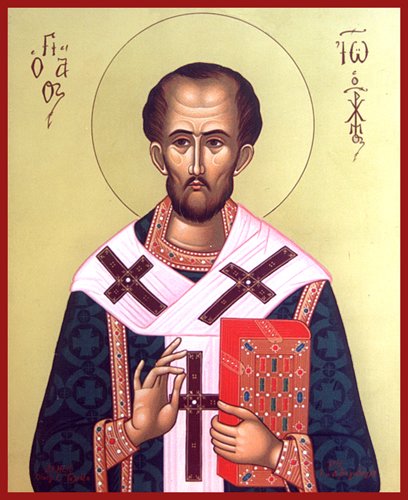
I have this saint in my saints' book, Catholic Saints Prayer Book.
"The ambiguity and intrigue surrounding John, the great preacher (his name means "golden-mouthed") from Antioch, are characteristic of the life of any great man in a capital city. Brought to Constantinople after a dozen years of priestly service in Syria, John found himself the reluctant victim of an imperial ruse to make him bishop in the greatest city of the empire. Ascetic, unimposing but dignified, and troubled by stomach ailments from his desert days as a monk, John began his episcopate under the cloud of imperial politics.
If his body was weak, his tongue was powerful. The content of his sermons, his exegesis of Scripture, were never without a point. Sometimes the point stung the high and mighty. Some sermons lasted up to two hours.
His life-style at the imperial court was not appreciated by some courtiers. He offered a modest table to episcopal sycophants hanging around for imperial and ecclesiastical favors. John deplored the court protocol that accorded him precedence before the highest state officials. He would not be a kept man.
His zeal led him to decisive action. Bishops who bribed their way into their office were deposed. Many of his sermons called for concrete steps to share wealth with the poor. The rich did not appreciate hearing from John that private property existed because of Adam's fall from grace any more than married men liked to hear that they were bound to marital fidelity just as much as their wives. When it came to justice and charity, John acknowledged no double standards.
Aloof, energetic, outspoken, especially when he became excited in the pulpit, John was a sure target for criticism and personal trouble. He was accused of gorging himself secretly on rich wines and fine foods. His faithfulness as spiritual director to the rich widow, Olympia, provoked much gossip attempting to prove him a hypocrite where wealth and chastity were concerned. His action taken against unworthy bishops in Asia Minor was viewed by other ecclesiastics as a greedy, uncanonical extension of his authority.
Two prominent personages who personally undertook to discredit John were Theophilus, Archbishop of Alexandria, and Empress Eudoxia. Theophilus feared the growth in importance of the Bishop of Constantinople and took occasion to charge John with fostering heresy. Theophilus and other angered bishops were supported by Eudoxia. The empress resented his sermons contrasting gospel values with the excesses of imperial court life. Whether intended or not, sermons mentioning the lurid Jezebel and impious Herodias were associated with the empress, who finally did manage to have John exiled. He died in exile in 407."
(From Saint of the Day)
Monday, September 1, 2008
Labor day with St. Joseph the worker
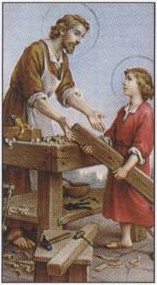
A Prayer for Workers
O glorious Joseph! Who concealed your incomparable and regal dignity of custodian of Jesus and of the Virgin Mary under the humble appearance of a craftsman and provided for them with your work, protect with loving power your sons, especially entrusted to you.
You know their anxieties and sufferings, because you yourself experienced them at the side of Jesus and of His Mother. Do not allow them, oppressed by so many worries, to forget the purpose for which they were created by God. Do not allow the seeds of distrust to take hold of their immortal souls. Remind all the workers that in the fields, in factories, in mines, and in scientific laboratories, they are not working, rejoicing, or suffering alone, but at their side is Jesus, with Mary, His Mother and ours, to sustain them, to dry the sweat of their brow, giving value to their toil. Teach them to turn work into a very high instrument of sanctification as you did. Amen.
[composed by Blessed Pope John XXIII (1958-63)]
Friday, August 1, 2008
Miracle in Chili attributed to Nicola D'Onofrio?
Santiago, Aug 1, 2008 / 10:23 am (CNA).- Maria Mercedes Correa Maldonado, a 23 year-old Chilean woman who in explicably “woke up” from cerebral palsy when she was 18, is now pregnant, in what could be the second miracle attributed to Italian seminarian Nicola D’Onofrio (1943-1964), whose cause of beatification is open in the Diocese of Rome.
Maria Mercedes suffered from grave cerebral palsy but on a March afternoon on 2003, after her mother had incessantly prayed to the Italian seminarian for his intercession, she woke up in her hospital bed in Puataendo, sat up and said, “I’m hungry.”
Inexplicable from a medical point of view, the case drew the attention of the Sons of St. Camillus, who are following D’Onofrio’s beatification process in Rome, which began in 2000.
Now, five years after her miraculous recovery, Maria Mercedes says she is experiencing a new miracle from D’Onofrio, as she has become pregnant despite doctors’ diagnoses that it would be impossible. “All the specialists who examined her came to the conclusion that she could never have any children. But now she is pregnant. It is a new miracle,” her mother said... (Continued here).
Maria Mercedes suffered from grave cerebral palsy but on a March afternoon on 2003, after her mother had incessantly prayed to the Italian seminarian for his intercession, she woke up in her hospital bed in Puataendo, sat up and said, “I’m hungry.”
Inexplicable from a medical point of view, the case drew the attention of the Sons of St. Camillus, who are following D’Onofrio’s beatification process in Rome, which began in 2000.
Now, five years after her miraculous recovery, Maria Mercedes says she is experiencing a new miracle from D’Onofrio, as she has become pregnant despite doctors’ diagnoses that it would be impossible. “All the specialists who examined her came to the conclusion that she could never have any children. But now she is pregnant. It is a new miracle,” her mother said... (Continued here).
Tuesday, July 29, 2008
St. Martha

"Martha was born of noble and wealthy parents, but she is still more illustrious for the hospitality she gave to Christ our Lord. After His Ascension into heaven, she was seized by the Jews, together with her brother and sister, Marcella her handmaid, and Maximin, one of the seventy two disciples of our Lord, who had baptized the whole family, and many other Christians. They were put on board a ship without sails or oars, and left helpless on the open sea, exposed to certain shipwreck. But God guided the ship, and they all arrived safely at Marseilles.
This miracle, together with their preaching, brought the people of Marseilles, of Aix, and of the neighborhood to believe in Christ. Lazarus was made Bishop of Marseilles and Maximin of Aix. Magdalen, who was accustomed to devote herself to prayer and to sit at our Lord's feet, in order to enjoy the better part which she had chosen, that is, contemplation of the joys of heaven, retired into a deserted cave on a very high mountain. There she lived for thirty years, separated from all human intercourse; and every day she was carried to heaven by the angels to hear their songs of praise.
But Martha, after having won the love and admiration of the people of Marseilles by the sanctity of her life and her wonderful charity, withdrew in the company of several virtuous women to a spot remote from men, where she lived for a long time, greatly renowned for her piety and prudence. She foretold her death long before it occurred; and at length, famous for miracles, she passed to our Lord on the fourth of the Kalends of August. Her body which lies at Tarascon is held in great veneration."
Excerpted from The Liturgical Year, Abbot Gueranger O.S.B.

"He Knows My Name" blogspot expresses this about St. Martha:
"She is mentioned three times in the Bible, but most people focus on only one - when Jesus was visiting and she wanted His help in getting her sister Mary off the floor to help do the dishes. Our gracious Lord reminded her that it was a good thing to sit awhile and listen, after all they may not get that opportunity again. It doesn't tell us how she responded to that, but if you read further about her I think you'll agree that she would have taken that to heart and learnt from it. In fact, she seemed a very focused woman. She did not appear to be an emotional personality like her sister, but rather seeing things in black and white. She saw there was work to do and set about doing it believing it to be necessary at that time, though Christ teaches her otherwise. Also, she wasn't complaining about working, just that Mary also had chores to do.
Further on, Lazarus has died. Mary is a mess. When Jesus arrives, days after they had sent word to Him, Martha rebukes Him. "Lord, if you had been here my brother would not have died." She doesn't hold back, BUT, can you see what else she is saying? She BELIEVES, without a doubt,that Christ has the power to heal her brother. No faltering faith for Martha. She is convinced (remember, I said she sees everything in black and white?).
Now, if that faith statement doesn't grab you the next one must!
She continues, without taking a breath, "BUT EVEN NOW, I KNOW THAT WHATEVER YOU ASK OF GOD, GOD WILL GIVE YOU." What a woman of faith in her Lord!!
She continues on declaring Him to be "...the Christ, the Son of God..."!"
Tuesday, July 22, 2008
Review from Hawaii on my book "Catholic Saints Prayer Book"

Our family's home is filled with Catholic books, especially books on the saints. Would there be new book on the saints that would stand out? Could there really be a Catholic saints book that would be different than the ones already sitting on our book shelves?
Well, when fellow Catholic blogger and online friend Donna-Marie Cooper O'Boyle gave me an opportunity to read and review her book, I was briefly hesitant to accept because I believed that it would just be another ordinary saints book.
However, after reading Donna's little book recently published by Our Sunday Visitor I can honestly say that this book truly stands out.
First of all, you can see it was a work of love on Donna's part. Here is a woman who is very spiritual and who has been blessed in her life to personally know a Catholic saint, Mother Teresa of Calcutta.
Then there is the fact that the book in itself is beautiful to behold. It reminded me of the old fashioned books with the lovely designs and elegant fonts. It was not a cheap paperback but a quality hardcover book.
The book itself is tiny in size yet packed full of interesting tidbits of favorite Catholic saints. Some of my favorite saints which I found covered in the book include:
- St. Augustine
- St. Faustina
- St. Francis
- St. John Chrysostom
- St. Maximilian Kolbe
- St. Padre Pio
- St. Rita of Cascia
- St. Thomas More
Actually, it was very enjoyable reading about all the saints that were selected by Donna. I believe I learned something new on just about all the saints that I had not known before. For example, I did not know that St. Augustine started living with a woman at the age of fifteen! I also did not know that the sisters of St. Bernadette's convent treated her so harshly!!
Each saint's page contains the feast day of that particular saint, a quote from either the saint, the Catechism of the Catholic Church or from scripture, a short list of all their patronages, (what they were patron saints of)a compact yet precise outline of the saint's biography and to make each entry special, Donna included a prayer for each particular saint. The little book also contains graphics that are not usually seen. For instance, St. Ignatius of Loyola's death mask.
The first time I opened the book to read it was when my family and I were at the airport waiting for my niece and nephew to arrive. I took out the little book to read and was soon absorbed in it. Before I knew it, my husband was looking over my shoulder to read along with me and then soon our son was doing the same thing. In order to be fair we took turns reading the lovely little saints book. My husband commented that that I should always carry the book in my purse. He said it was a treasure. I thought that was an excellent suggestion and so that is what I have been doing since receiving the book.
I really hope that if you are looking for a book on the saints that will captivate your family's interest and also be a prayer book for yourself, that you will consider buying this beautiful little book.
Mahalo Donna for the opportunity to read your new book.
Thank you very much, Esther! Your words are very kind and your review is thorough. Someday I'd love to visit with you in Hawaii!
God bless and hugs,
Donna-Marie
PS Esther has a very beautiful Catholic blog from Hawaii. Go take a look at her Hawaiian Catholic blog, "A Catholic Mom in Hawaii" here!
Thursday, July 17, 2008
Review of Catholic Saints Prayer Book

Mary Rose at True Confessions of a Prodigal Daughter just posted a beautiful review about my saints' book. I think you'll find it interesting how she came to love the saints. Perhaps some of you can relate. Her review is here:
I've had the pleasure of meeting Donna-Marie Cooper O'Boyle online and have been touched by her dedication to encouraging women and celebrating overall her Catholic faith. She is a humble lady, simply wanting to share her love for God with everyone she meets. I can't fathom how she finds time to write since she has five wonderful kids and a husband. Talk about busy!
She sent me her book, Catholic Saints Prayer Book. It is a beautiful small volume, perfect for giving to a teacher or even your college-bound sons and daughters. (Giving college kids anything about saints is an excellent idea.)

The hardbound book is beautifully designed, with a lovely painting on the cover and illustrations inside. The pages are a soft gloss, with a calming green decorative border on the edges of each page. Donna-Marie managed to concisely capture the birth and death dates for each saint, their Feast Day, the saint's patronage, information about their life, and a prayer to that particular saint. Here is one of my favorites:
Prayer to St. Joseph
Dear St. Joseph, you were an ordinary man, a humble carpenter. But you were a prayerful, holy soul, the foster father of Jesus, a model for us all. Please guide me in my own journey through life, and help me be aware of God's specific call to me. Help me to see that in my own life God is calling me to greater things for His glory. Please pray to the Blessed Trinity for me to be granted the graces that I need most. I pray that I can be faithful to my state of life, totally trusting in God's divine providence for me. St. Joseph, pray for all who invoke your aid. If it is in God's holy will, please grant me (here mention your request). Amen.
Isn't that wonderful? I just love this little book of the saints.
I have to admit, appreciating the saints has taken some time. I have witnessed years of anti-Catholic perspectives. One of the biggest gripes Protestants and non-denominational believers have with Catholics is their presumed "praying to the saints." For years, I would declare, "There is no mediator between God and man but Jesus Christ." Of course, no one else could have redeemed us but Jesus Christ. No other sacrifice would do but a perfect one and Jesus Christ was the only one qualified to do it. He was, is, and shall be forever perfect, loving His heavenly Father with perfection, doing His will with complete surrender. No one can or should ever take the place of Jesus Christ.
However, I think my non-Catholic brothers and sisters misunderstand what is going on when Catholics venerate the saints. When prayers are offered up (I am partial to the very brief, "Pray for me, St. Joseph!") I am not worshipping St. Joseph, but asking St. Joseph to count me in his prayers and supplications before the throne of God.
Hebrews 12:1,2 says:
Therefore, since we are surrounded by so great a cloud of witnesses, let us also lay aside every weight, and sin which clings so closely, and let us run with perseverance the race that is set before us, looking to Jesus the pioneer and perfecter of our faith, who for the joy that was set before him endured the cross, despising the shame, and is seated at the right hand of the throne of God. (RSV)
You know, I've read those verses many, many times. I just thought the witnesses watched. But who could watch a race and not cheer? St. Paul was telling the Jewish believers that they had support. These verses took on fresh meaning as I realized those who have gone before us are now in heaven, praying for the Church to be perfected. Doesn't that make sense?
Aren't we asking the saints to put in a few prayers on our behalf that we would be made worthy of the promises of Christ? Of course. I still worship Jesus Christ for who He is and petition our Heavenly Father for all things. Scripture also tells us that the Holy Spirit makes intercession for us:
Likewise the Spirit helps us in our weakness; for we do not know how to pray as we ought, but the Spirit himself intercedes for us with sighs too deep for words. And he who searches the hearts of men knows what is the mind of the Spirit, because the Spirit intercedes for the saints according to the will of God. (Rom. 8:26, 27 RSV)
Ever since I've started to embrace the saints more, I have felt a new confidence enter my faith. I feel as though I do have a huge group of saints who are pulling for me. They know how difficult the journey can be and they are praying that we can overcome our trials and tribulations.
Donna-Marie's Catholic Saint Prayer Book is the perfect way to encourage others that they also have a group of saints who are "pulling for them" to persevere. It's a great gift for either yourself or someone you love. Enjoy it and be blessed! Click on the title to order.
(The above photos are from Mary Rose's blog)
Monday, July 14, 2008
Blessed Kateri Tekawitha

Kateri was born in 1656 near the town of Auriesville, New York, the daughter of a Mohawk warrior. She was baptized by Jesuit missionary Fr. Jacques de Lambertville on Easter of 1676 at the age of twenty. She devoted her life to prayer, penitential practices, and the care of the sick and aged in Caughnawaga near Montreal (where her relics are now enshrined). She incurred the hostility of her tribe because of her faith. She was devoted to the Eucharist, and to Jesus Crucified, and was called the "Lily of the Mohawks." She died in 1680 and was beatified June 22, 1980 — the first native American to be declared "Blessed." — Magnificat, July 2003
According to the 1962 Missal of Bl. John XXIII the Extraordinary Form of the Roman Rite, today is the feast of St. Bonaventure. His feast in the Ordinary Form of the Roman Rite is celebrated on July 15. (From Catholic Culture)
More from Catholic Culture:
Bl. Kateri Tekakwitha
[Pronounce: Gah-deh-lee Deh-gah-quee-tah]
The blood of martyrs is the seed of saints. Nine years after the Jesuits Isaac Jogues and John de Brebeuf were tortured to death by Huron and Iroquois Native American nations, a baby girl was born near the place of their martyrdom, Auriesville, New York. She was to be the first person born in North America to be beatified. Her mother was a Christian Algonquin, taken captive by the Iroquois and given as wife to the chief of the Mohawk clan, the boldest and fiercest of the Five Nations. When she was four, Kateri lost her parents and little brother in a smallpox epidemic that left her disfigured and half blind. She was adopted by an uncle, who succeeded her father as chief. He hated the coming of the Blackrobes (missionaries), but could do nothing to them because a peace treaty with the French required their presence in villages with Christian captives. She was moved by the words of three Blackrobes who lodged with her uncle, but fear of him kept her from seeking instruction. She refused to marry a Mohawk man and at nineteen finally got the courage to take the step of converting. She was baptized with the name Kateri (Catherine) on Easter Sunday... (Continued here)
Wednesday, July 9, 2008
Vatican moving forward on Fr. Damien and Parents of St. Therese

Vatican City, Jul 3, 2008 / 10:50 am (CNA).- The head of the Congregation for the Causes of the Saints, Cardinal Jose Saraiva Martins, met with Pope Benedict today to present him with 14 causes for canonization in their various stages. Among those approved for advancement towards sainthood are Fr. Damien De Veuster, a Belgian missionary to Hawaii, and the parents of St. Therese of Lisieux.
The miracle attributed to Fr. Damien is the cure of Audrey Toguchi, a 79-year-old retired schoolteacher who became ill in 1997 with a cancerous lump on her left thigh.
Upon discovering her cancer, Toguchi went to Fr. Damien’s grave and asked him to intercede for her healing. She then underwent surgery, but her doctor informed her afterwards that he could do nothing more since the cancer had spread to her lungs. Toguchi turned once again to Fr. Damien and the cancer soon began to inexplicably disappear of a four month period. For a full explanation of the miracle please visit: http://www.catholicnewsagency.com/new.php?n=12523
The miracle credited to the parents of St. Therese involved the healing of Pietro Schiliro, an Italian newborn who was born in 2002 with partial lungs. The condition was so grave that doctors could do nothing and Pietro’s parents immediately had him baptized.
The Schiliro’s also began a novena to St. Therese’s parents and within a few weeks the Pietro made an unexpected recovery.
The full list of those advancing along the road to sainthood along with the various steps being recognized is listed below... (Continued here).
Italian teen is getting closer to sainthood

This extraordinary teen's last words were, “Ciao. Be happy because I am.”
Rome, Jul 7, 2008 / 05:56 pm (CNA).- The Congregation for the Causes of the Saints issued a decree last week recognizing the heroic virtues of Chiara “Luce” Badano, a young Italian girl who belonged to the Focolare Movement and died in 1990 at the age of 18.
The new “Venerable” Chiara was born in Sassello, Liguria, on October 29, 1971, to the joy of her parents, truck driver Ruggero Badano, and Maria Teresa Caviglia, who waited eleven years to have a child.
“Amidst our great joy, we understood immediately that she was not only our daughter but also a daughter of God,” her mother said according to a biography published by Focolare.
Since childhood, Chiara showed a deep love for God and a strong but docile character. She was joyful, kind and very active.
At the age of nine she joined the Focolare Movement. In 1985 Chiara moved to Savona to continue her education, and according to her biographers, “She had a difficult time despite her great efforts. She was held back one year and this made her suffer greatly.”
Chiara had many friends and loved sports, especially tennis, swimming and hiking. She dreamed of being a flight attendant and enjoyed dancing and singing. However, at the age of 16 she decided to pursue the consecrated life.
She had a close relationship with the foundress of the Focolare, Chiara Lubich, who gave her the name, “Luce.”
Soon afterwards she was diagnosed with a cancerous tumor in her shoulder. She began intense chemotherapy while she continued her daily life with the same joy and faith.
This joy and faith moved Chiara to give all of her savings to a friend who was going to be a missionary in Africa, even though she was ill.
Despite the efforts by doctors, her illness progressed rapidly and she lost the use of her legs. “If I had to choose between walking or going to heaven I’d choose heaven,” she told her family... (Continued here)
Sunday, July 6, 2008
St Maria Goretti

"Maria Goretti was born on October 16, 1890 in Corinaldo, Italy to Luigi Goretti and Assunta Carlini. The Gorettis were a poor family who worked as sharecroppers in the Pontine marshes. Along with their six children, they lived with Luigi’s partner Signor Serenelli and his teenaged son Allesandro, whose mother had died.
Maria’s father died when she was just nine, so she assumed many of the household responsibilities while her mother worked in the fields. She cared for her siblings and the Serenellis, all in perfect charity. Her cheerful nature was well-known in Pontine, where most children her age would play in the dusty streets. Though unable to read and write, Maria knew and loved Jesus and Mary, and one of the most important events of her life was her First Holy Communion, for which she diligently prepared..." (Continued at Catholic Exchange)
The beautiful holy card is courtesy of Holy Cards for Your Inspiration
Friday, July 4, 2008
St. Elizabeth of Portugal

Elizabeth, a Spanish princess, was born in 1271. She married King Denis of Portugal at the age of twelve. Elizabeth was beautiful and very lovable. She was also devout and went to Mass every day. Elizabeth was a charming wife. Her husband was fond of her at first, but soon he began to cause her great suffering. Though a good ruler, he did not have his wife's love of prayer and virtue. In fact, his sins of impurity were well-known scandals throughout his kingdom. St. Elizabeth tried to be a loving mother to her children, Alphonso and Constance. She was also generous and loving with the people of Portugal. Even though her husband was unfaithful, she prayed that he would have a change of heart. Elizabeth refused to become bitter and resentful. She strengthened her own prayer life and followed the Franciscan spirituality. Gradually, the king was moved by her patience and good example. He began to live better. He apologized to his wife and showed her greater respect. In his last sickness the queen never left his side, except for Mass. King Denis died on January 6, 1325. He had shown deep sorrow for his sins and his death was peaceful. Eiizabeth lived eleven more years. She performed loving acts of charity and penance. She was a wonderful model of kindness toward the poor. This gentle woman was also a peacemaker between members of her own family and between nations. St. Elizabeth of Portugal died on July 4, 1336. She was proclaimed a saint by Pope Urban VIII in 1626. "If you love peace, all will be well."-St. Elizabeth
Thursday, July 3, 2008
The Feast of St. Thomas

St. Thomas, the disciple who at first did not believe, has become for the Church one of the first witnesses to her faith. She is fond of appealing to his testimony and frequently puts in our mouths those simple words whereby he expressed the fervour of his regained faith: "My Lord and my God." It is known that St. Thomas preached the Gospel in Asia beyond the frontiers of the Roman Empire, probably in Persia and possibly as far afield as India. St. Thomas' feast was formerly celebrated on December 21.
Before the reform of the General Roman Calendar today was the feast of St. Leo II, one of the last Popes of the early Middle Ages. His short pontificate (682-683) was marked by the confirmation of the sixth ecumenical council at which the Monothelite heresy was condemned. St. Leo II also perfected the melodies of the Gregorian chant for the Psalms and composed some new hymns. (From Catholic Culture)
Review of my "Catholic Saints Prayer Book"

Ebeth from A Catholic Mom Climbing the Pillars just posted this on her blog:
"The FedEx guy just came by with a wonderful surprise, Donna-Marie Cooper O'Boyle's book, "Catholic Saints Prayer Book, Moments of Inspiration from your favorite Saints".
Now, at first glance, I thought, "Wow! small enough to fit in my purse!" I am impressed with the durable hardcover, so classy and the saints are in alphabetical order...great! I can find the one I'm looking for quickly and she lists what they are a patron saint for. It's a great little book to carry with you, throw in the car, keep under your pillow or send to a friend.
More about this little morsel later, I am going to be reading it and I'll report back here with more details!
Thanks Donna-Marie! You are the best!"
No, actually Ebeth, YOU ARE the best! Thank you very much!
God bless and hugs,
Donna-Marie
Sunday, June 29, 2008
From "A Friar's Life:" Sent as Missionaries to the World
This is the homily from our assistant pastor, Fr. Tom for today's Mass. I think it's great.
Solemnity of Sts. Peter and Paul, June 29, 2008
"Today begins a historic chapter in the history of the Church: The Jubilee Year of St Paul. Pope Benedict has declared this a year dedicated to remembering this great saint as we commemorate the 2,000th anniversary of his birth. The pope calls every Catholic to get to know St. Paul better during this year. Why? Because he is simply an extraordinary example of what God can do when we cooperate with His plans.
Paul is a man of great transformation. Through the grace of God, he went from being a murderer of Christians to being a martyr for Christ. Paul was first a devout Jew bent on crushing this Christian movement. At the height of his violent campaign, Jesus appeared to Paul, while he was on his way to Damascus to arrest the Christians there. That encounter completely changed his life, and the course of his history and ours.
He became the great missionary who tirelessly traveled for almost 30 years, starting Christian communities in city after city, preaching and suffering, and writing a major portion of the New Testament. Next to Jesus, Paul is the most prominent person in the New Testament. Of its 27 books, 13 are letters attributed to Paul. More than half of the Acts of the Apostles is devoted to his conversion and his activities spreading the good news about Jesus to the world..." (Continued here)
Solemnity of Sts. Peter and Paul, June 29, 2008
"Today begins a historic chapter in the history of the Church: The Jubilee Year of St Paul. Pope Benedict has declared this a year dedicated to remembering this great saint as we commemorate the 2,000th anniversary of his birth. The pope calls every Catholic to get to know St. Paul better during this year. Why? Because he is simply an extraordinary example of what God can do when we cooperate with His plans.
Paul is a man of great transformation. Through the grace of God, he went from being a murderer of Christians to being a martyr for Christ. Paul was first a devout Jew bent on crushing this Christian movement. At the height of his violent campaign, Jesus appeared to Paul, while he was on his way to Damascus to arrest the Christians there. That encounter completely changed his life, and the course of his history and ours.
He became the great missionary who tirelessly traveled for almost 30 years, starting Christian communities in city after city, preaching and suffering, and writing a major portion of the New Testament. Next to Jesus, Paul is the most prominent person in the New Testament. Of its 27 books, 13 are letters attributed to Paul. More than half of the Acts of the Apostles is devoted to his conversion and his activities spreading the good news about Jesus to the world..." (Continued here)
St. Peter and St. Paul

ST. PETER AND ST. PAUL St. Peter Peter, the first pope, was a fisherman from Galilee. Jesus invited him to follow him, saying: "I will make you a fisher of men." Peter was a simple, hard-working man. He was generous, honest and very attached to Jesus. This great apostle's name was Simon, but Jesus changed it to Peter, which means "rock." "You are Peter," Jesus said, "and on this rock I will build my Church." Peter was the chief or prince of the apostles. When Jesus was arrested, Peter became afraid. It was then that he committed the sin of denying Our Lord three times. Fear for his safety got the best of him. But Peter repented totally. He wept over his denials for the rest of his life. Jesus forgave Peter. After his resurrection he asked Peter three times: "Do you love me?" "Lord," Peter answered, "you know all things. You know that I love you." Jesus truly did know! Peter was so right. Jesus said kindly: "Feed my lambs. Feed my sheep." He was telling Peter to take care of his Church because he would be ascending into heaven. Jesus left Peter as the leader of his followers. Peter eventually went to Rome to live. Rome was the center of the whole Roman Empire. Peter converted many nonbelievers there. When the fierce persecution of Christians began, they begged Peter to leave Rome and save himself. It is said that he actually started out. On the road he met Jesus. Peter asked him, "Lord, where are you going?" Jesus answered, "I am coming to be crucified a second time." Then St. Peter turned around and went back. He realized that this vision meant that he was to suffer and die for Jesus. Soon after, he was taken prisoner and condemned to death. Because he was not a Roman citizen, he, like Jesus, could be crucified. This time he did not deny the Lord. This time he was ready to die for him. Peter asked to be crucified with his head downward since he was not worthy to suffer as Jesus had. The Roman soldiers did not find this unusual because slaves were crucified in the same manner. St. Peter was martyred on Vatican Hill. It was around the year 67. Emperor Constantine built a large church over that sacred location in the fourth century. Recent archaeological findings confirm these facts. St. Paul Paul is the great apostle who first persecuted the Christians. Then he was converted. We celebrate Paul's conversion on January 25. At the time of his conversion, Jesus had said: "I will show him how much he must suffer for me." St. Paul loved Jesus very much, so much, in fact, that he became a living copy of our Savior. All his life, during his many missionary trips, St. Paul met troubles and went through dangers of every kind. He was whipped, stoned, shipwrecked, and lost at sea. Many, many times he was hungry, thirsty and cold. Yet he always trusted in God. He never stopped preaching. "The love of Jesus presses me onward," he said. In reward, God gave him great comfort and joy in spite of every suffering. We read about his marvelous adventures for Christ in Luke's Acts of the Apostles, beginning with chapter nine. But St. Luke's story ends when Paul arrives in Rome. He is under house arrest, waiting to be tried by Emperor Nero. A famous early Christian writer, Tertullian, tells us that Paul was freed after his first trial. But then he was put in prison again. This time he was sentenced to death. He died around the year 67, during Nero's terrible persecution of the Christians. Paul called himself the apostle of the Gentiles. He preached the Gospel to the non-Jews. That took him to the whole known world. Because of Paul, we, too, have received the Christian faith. May our hearts be filled with joy as we honor these two great apostles: Peter, our leader in the faith, and Paul, its fearless preacher.
Friday, June 27, 2008
Review of Catholic Saints Prayer Book

By Hugh J.McNichol
The Catholic Church's arsenal of saints is truly a resource that is sadly overlooked by contemporary Catholics. Donna's synopsis of the lives of popular saints is a welcome addition to my spiritual reading library. The heroic lifestyles of the holy men and women that are portrayed in such a clearly spiritual manner by the author are refreshing reminders that all of us as Catholics are called to the ultimate vocation of sainthood. A great book for catechesis and religious education for all levels of faithful Catholics and those interested in learning about the "pillars" of Catholicism. Well done, this book is inspiration to Catholics seeking to identify more closely with the spiritual "heavy-hitters" that have achieved the ultimate title...Saint! Donna-Marie Cooper O’Boyle has done a great job bringing the great Catholic saints into our unique 21st century perspective.
You can see this review here and there's a place to post a comment.
St. Cyril, Patriarch of Alexandria

"St. Cyril, Patriarch of Alexandria, one of the metropolitan sees of the Christian Church in the east, was one of the great defenders of the faith against the heresy of Nestorius who denied the oneness of person in Jesus Christ. At the Council of Ephesus in 431, over which he presided in the Pope's name, and at his instigation, it was defined that Christ, the Son of God, is at the same time God and man, and the Blessed Virgin Mary, His mother, is truly the Mother of God. St. Cyril died in 444. The Church venerates him as one of her great doctors. His commentary on the Gospel of St. John is one of the richest doctrinally of those left us by the Fathers of the Church.
According to the 1962 Missal of Bl. John XXIII the Extraordinary Form of the Roman Rite, the feast of St. Cyril of Alexandria is celebrated on February 9." (from Catholic Culture)
You can read Orientalis Ecclesiae (On St. Cyril, Patriarch Of Alexandria)
by Pope Pius XII here:
To Our Venerable Brethren the Patriarchs, Primates, Archbishops, Bishops and other Ordinaries at Peace and in Communion with the Apostolic See
Venerable Brethren, Health and Our Apostolic Benediction
St. Cyril, Patriarch of Alexandria, glory of the Eastern Church and celebrated champion of the Virgin Mother of God, has always been held by the Church in the highest esteem, and We welcome the opportunity of recalling his merits in this brief Letter, now that fifteen centuries have passed since he happily exchanged this earthly exile for his heavenly home.
2. Our Predecessor St. Celestine I hailed him as 'good defender of the Catholic faith,'[1] as 'excellent priest,'[2] as 'apostolic man.'[3] The ecumenical Council of Chalcedon not only used his doctrine for the detecting and refuting of the latest errors, but went so far as to compare it with the learning of St. Leo the Great;[4] and in fact the latter praised and commended the writings of this great Doctor because of their perfect agreement with the faith of the holy Fathers.[5] The fifth ecumenical Council, held at Constantinople, treated St. Cyril's authority with similar reverence[6] and many years later, during the controversy about the two wills in Christ, his teaching was rightly and triumphantly vindicated, both in the first Lateran Council[7] and in the sixth ecumenical Council, against the false charge of being tainted with the error of Monothelitism. He was, as Our saintly Predecessor Agatho proclaimed, 'a defender of the truth'[8] and 'a consistent teacher of the orthodox faith.'[9]
3. We therefore think it proper in this Letter to give some account of his spotless life, faith, and virtue; and this for the benefit of all, but especially of those who belong to the Eastern Church and therefore have good reason to be proud of this luminary of Christian wisdom, this valiant hero of the apostolate.
4. Born of distinguished family, he was raised to the See of Alexandria--so tradition tells us--in the year 412. His first conflict was with the Novatians and others who attacked the integrity and purity of the faith, and against these he preached, wrote, and issued decrees, ever alert, ever fearless. Later, when the blasphemous heresy of Nestorius began to spread gradually through the East the watchful Pastor was quick to perceive the growth of these new errors and zealous in protecting his flock against them. Throughout this stormy period, and especially at the Council of Ephesus, he showed himself the invincible champion and learned teacher of the divine maternity of the Virgin Mary, of the hypostatic union in Christ, and of the Primacy of the Roman Pontiff. But the leading part which St. Cyril played in these important events has already been admirably described and explained by Our immediate Predecessor of happy memory Pius XI, in the Encyclical Lux Veritatis[10] with which in the year 1931 he celebrated the fifteenth centenary of that ecumenical Council, and therefore it would be superfluous to enter into the details of it here.
5. For Cyril, however, it was not enough to fight vigorously against heresies as they arose, not enough to guard the integrity of Catholic doctrine with energy and solicitude and throw the fullest possible light upon it; he was also untiring in his labors to recall his erring brethren to the straight path of the truth. For when the Bishops of the Province of Antioch were still refusing to recognize the authority of the holy Council of Ephesus, it was due to his efforts that they were at length, after long vicissitudes, brought to complete agreement. And it was only after he had succeeded with God's help in accomplishing this happy reunion and in guarding and securing it against misconceptions that, being now ripe for the reward of everlasting glory, he was taken up to heaven in the year 444, mourned by all men of good will... (Continued here.)
Thursday, June 19, 2008
Canticle is out!

The latest issue of Canticle magazine is out and my cover story is, "Women Thirsting for the Living Water: Mulieris Dignitatem and the International Women's Congress in Rome."
Thursday, June 12, 2008
An approved prayer asking for Pope John Paul II's intercession

O Holy Trinity,
we thank you for having given to the Church
Pope John Paul II,
and for having made him shine with your fatherly tenderness,
the glory of the Cross of Christ and the splendour of the Spirit of love
He, trusting completely in your infinite mercy
and in the maternal intercession of Mary, has shown himself
in the likeness of Jesus the Good Shepherd
and has pointed out to us holiness
as the path to reach eternal communion with You.
Grant us, through his intercession,
according to your will, the grace that we implore,
in the hope that he will soon be numbered among your saints.
Amen.
(Taken from:
L'Osservatore Romano
Weekly Edition in English
6 July 2005, page 9)
L'Osservatore Romano is the newspaper of the Holy See.
The Weekly Edition in English is published for the US by:
The Cathedral Foundation
L'Osservatore Romano English Edition
320 Cathedral St.
Baltimore, MD 21201
Subscriptions: (410) 547-5315
Fax: (410) 332-1069
lormail@catholicreview.org
--------------------------------------------------------------------------------
Provided Courtesy of:
Eternal Word Television Network
5817 Old Leeds Road
Irondale, AL 35210
www.ewtn.com
Subscribe to:
Posts (Atom)


 Posts
Posts


